

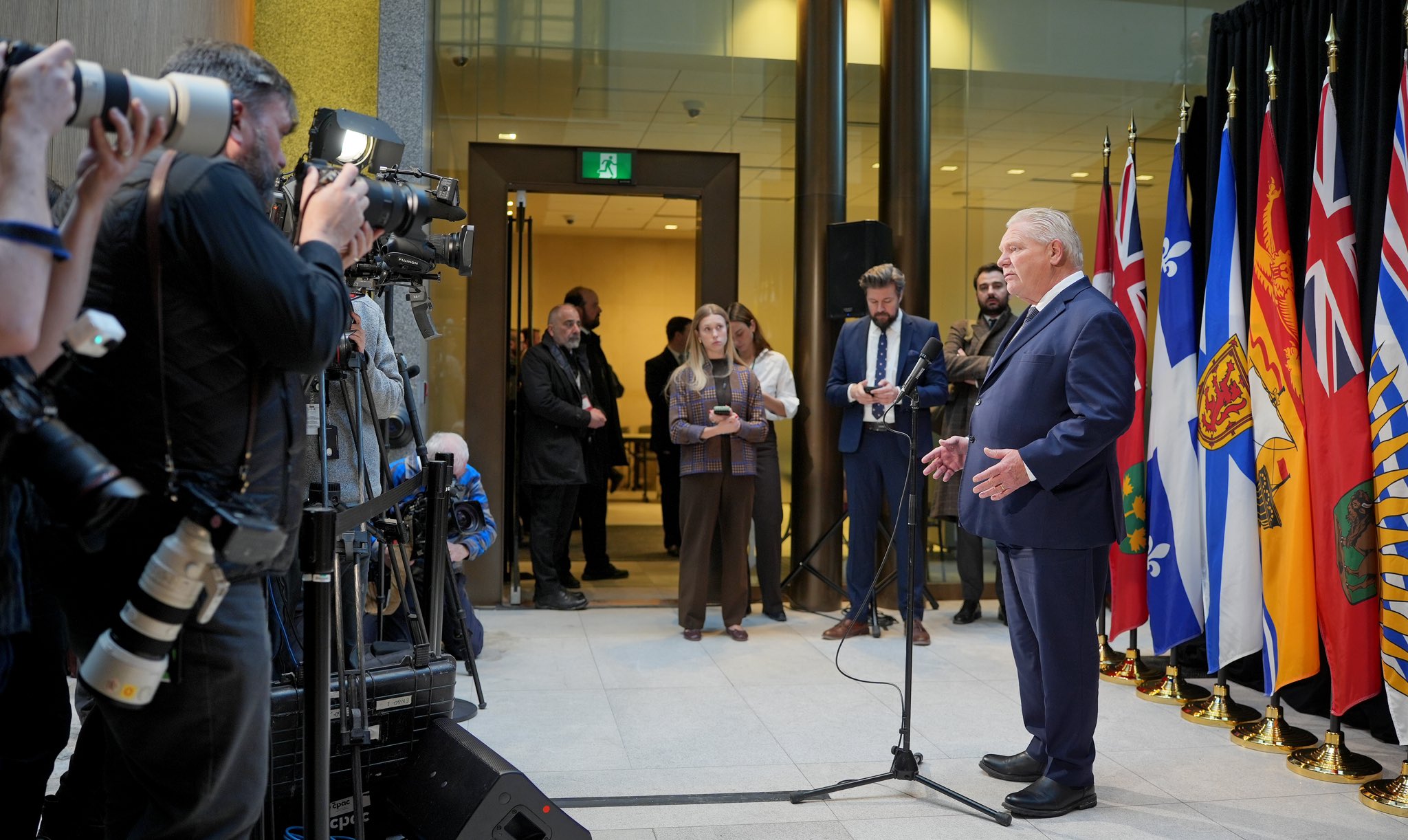
Ford speaking to reporters.

Ontario is currently engaged in a massive “Buy vs. Build” experiment. While the provincial government promised $2.5 billion to Honda, $4.3 billion to Volkswagen and $5 billion to Stellantis to lure foreign-owned companies, it invests just $90 million in Venture Ontario, $25 million in Regional Innovation Centers or $20 million in IP Ontario, the organizations tasked with building our future. We are spending billions on buying foreign factory jobs while leaving scraps for our local entrepreneurs to build our own economy.
The provincial government’s current economic development strategy will never result in a resilient economy. Despite billions in incentives, Stellantis has already relocated jobs from Brampton to Illinois, while Honda has postponed its electric-vehicle project. Even when companies build factories in Ontario, they may provide paychecks today, but we don’t own any of the intellectual property and see little in the way of tax revenue from the billions in profits reported in other countries. The Premier is jerry-rigging an economy that could topple with a decision made in Detroit, Wolfsburg or Tokyo.
Not only is this strategy expensive, outdated, and dangerous in the current geopolitical climate, but it also overlooks Ontarians’ potential to build our own economy. Ontario has some of the world’s best innovators, and our failure to support domestic innovation is costing us more jobs than the Premier can buy.
Consider the foundational research conducted by Dr. Daniel Drucker at the University of Toronto and Mount Sinai Hospital, which led to the development of GLP-1 drugs like Ozempic. If Ontario had a coordinated strategy to anchor that IP and mobilize capital, the billions in revenue and thousands of jobs that research has created would be right here in Ontario, where the technology was developed.
As our Federal Minister of AI and Digital Innovation, Evan Solomon said: “We plant the seed, we water, we grow, and someone else harvests?”
Ontario needs a dedicated Minister of Innovation who would move beyond this 20th-century playbook and focus on laying the foundations of a sovereign 21st-century economy.
A new Minister of Innovation should have three primary objectives: securing our IP, mobilizing capital and modernizing procurement.
Ontario needs a sovereign IP strategy; we can no longer afford to treat Ontario taxpayer-funded research as a subsidy to the world’s innovation ecosystem. We invented modern AI. Why is it that the world’s biggest AI companies are not based in Toronto? A dedicated minister could ensure that the next breakthrough in biotech or AI is commercialized in Ontario, creating jobs and tax revenues for our economy.
Canada lacks capital in the innovation ecosystem. In 2025, all Canadian venture capital firms combined raised $2.1 billion. Earlier this month, a single US firm, a16z, announced a US $15 billion raise. That’s a single American firm raising 10 times as much money a few weeks into 2026 as our entire industry did in 2025. The issue has become so severe that the world’s most prominent startup accelerator, Y Combinator, the force behind companies like DoorDash, Instacart, Dropbox, Stripe and Cruise, announced a decision that it would no longer invest in Canadian companies due to their difficulty in accessing capital. While the decision was later reversed, we need a minister focused on creating incentives to mobilize domestic capital from pension funds, corporations, and individuals, and on attracting foreign investment into our venture firms, ensuring we have the capital to match the ambition of our innovators.
Not only do Ontario’s startups need capital investment, they need local customers. Ontario’s public sector is the province’s largest customer. Instead of pursuing global trade missions, our provincial government should rebuild our procurement system to become the first buyer of local technologies, giving our startups the initial customer they need before scaling globally. Too often, Ontario’s entrepreneurs feel they need to validate their technology abroad before the Ontario government will consider working with them.
Premier Ford can address these issues by appointing a Minister of Innovation. Ontario’s economy cannot rely on buying paychecks; it needs to be built on a reliable foundation of innovation, intellectual property, and local entrepreneurs.
Minister Solomon’s effectiveness proves the value of the position. Last week, Mila, the Quebec Artificial Intelligence Institute, and Montreal-based Inovia Capital announced a $125 million fund to support early-stage AI innovators. Mila’s president and CEO, Valérie Pisano, specifically mentioned Minister Solomon’s priorities when discussing the fund’s motivation. Ontario needs a provincial counterpart to ensure similar investments are made in Ontario’s talent.
The “Buy vs. Build” experiment is a risky bet that leaves Ontario dependent on foreign corporations for our survival. The appointment of a provincial Minister of Innovation would be the first step toward building a more resilient economy, less dependent on foreign corporations and able to thrive on local technological innovations.
Liam Gill is a former startup founder and lawyer. He lives in Spadina-Fort York and supports innovative Canadian technology startups in raising the capital required to grow and scale in Canada.
Ontario is currently engaged in a massive “Buy vs. Build” experiment. While the provincial government promised $2.5 billion to Honda, $4.3 billion to Volkswagen and $5 billion to Stellantis to lure foreign-owned companies, it invests just $90 million in Venture Ontario, $25 million in Regional Innovation Centers or $20 million in IP Ontario, the organizations tasked with building our future. We are spending billions on buying foreign factory jobs while leaving scraps for our local entrepreneurs to build our own economy.
The provincial government’s current economic development strategy will never result in a resilient economy. Despite billions in incentives, Stellantis has already relocated jobs from Brampton to Illinois, while Honda has postponed its electric-vehicle project. Even when companies build factories in Ontario, they may provide paychecks today, but we don’t own any of the intellectual property and see little in the way of tax revenue from the billions in profits reported in other countries. The Premier is jerry-rigging an economy that could topple with a decision made in Detroit, Wolfsburg or Tokyo.
Not only is this strategy expensive, outdated, and dangerous in the current geopolitical climate, but it also overlooks Ontarians’ potential to build our own economy. Ontario has some of the world’s best innovators, and our failure to support domestic innovation is costing us more jobs than the Premier can buy.
Consider the foundational research conducted by Dr. Daniel Drucker at the University of Toronto and Mount Sinai Hospital, which led to the development of GLP-1 drugs like Ozempic. If Ontario had a coordinated strategy to anchor that IP and mobilize capital, the billions in revenue and thousands of jobs that research has created would be right here in Ontario, where the technology was developed.
As our Federal Minister of AI and Digital Innovation, Evan Solomon said: “We plant the seed, we water, we grow, and someone else harvests?”
Ontario needs a dedicated Minister of Innovation who would move beyond this 20th-century playbook and focus on laying the foundations of a sovereign 21st-century economy.
A new Minister of Innovation should have three primary objectives: securing our IP, mobilizing capital and modernizing procurement.
Ontario needs a sovereign IP strategy; we can no longer afford to treat Ontario taxpayer-funded research as a subsidy to the world’s innovation ecosystem. We invented modern AI. Why is it that the world’s biggest AI companies are not based in Toronto? A dedicated minister could ensure that the next breakthrough in biotech or AI is commercialized in Ontario, creating jobs and tax revenues for our economy.
Canada lacks capital in the innovation ecosystem. In 2025, all Canadian venture capital firms combined raised $2.1 billion. Earlier this month, a single US firm, a16z, announced a US $15 billion raise. That’s a single American firm raising 10 times as much money a few weeks into 2026 as our entire industry did in 2025. The issue has become so severe that the world’s most prominent startup accelerator, Y Combinator, the force behind companies like DoorDash, Instacart, Dropbox, Stripe and Cruise, announced a decision that it would no longer invest in Canadian companies due to their difficulty in accessing capital. While the decision was later reversed, we need a minister focused on creating incentives to mobilize domestic capital from pension funds, corporations, and individuals, and on attracting foreign investment into our venture firms, ensuring we have the capital to match the ambition of our innovators.
Not only do Ontario’s startups need capital investment, they need local customers. Ontario’s public sector is the province’s largest customer. Instead of pursuing global trade missions, our provincial government should rebuild our procurement system to become the first buyer of local technologies, giving our startups the initial customer they need before scaling globally. Too often, Ontario’s entrepreneurs feel they need to validate their technology abroad before the Ontario government will consider working with them.
Premier Ford can address these issues by appointing a Minister of Innovation. Ontario’s economy cannot rely on buying paychecks; it needs to be built on a reliable foundation of innovation, intellectual property, and local entrepreneurs.
Minister Solomon’s effectiveness proves the value of the position. Last week, Mila, the Quebec Artificial Intelligence Institute, and Montreal-based Inovia Capital announced a $125 million fund to support early-stage AI innovators. Mila’s president and CEO, Valérie Pisano, specifically mentioned Minister Solomon’s priorities when discussing the fund’s motivation. Ontario needs a provincial counterpart to ensure similar investments are made in Ontario’s talent.
The “Buy vs. Build” experiment is a risky bet that leaves Ontario dependent on foreign corporations for our survival. The appointment of a provincial Minister of Innovation would be the first step toward building a more resilient economy, less dependent on foreign corporations and able to thrive on local technological innovations.
Liam Gill is a former startup founder and lawyer. He lives in Spadina-Fort York and supports innovative Canadian technology startups in raising the capital required to grow and scale in Canada.
Ontario is currently engaged in a massive “Buy vs. Build” experiment. While the provincial government promised $2.5 billion to Honda, $4.3 billion to Volkswagen and $5 billion to Stellantis to lure foreign-owned companies, it invests just $90 million in Venture Ontario, $25 million in Regional Innovation Centers or $20 million in IP Ontario, the organizations tasked with building our future. We are spending billions on buying foreign factory jobs while leaving scraps for our local entrepreneurs to build our own economy.
The provincial government’s current economic development strategy will never result in a resilient economy. Despite billions in incentives, Stellantis has already relocated jobs from Brampton to Illinois, while Honda has postponed its electric-vehicle project. Even when companies build factories in Ontario, they may provide paychecks today, but we don’t own any of the intellectual property and see little in the way of tax revenue from the billions in profits reported in other countries. The Premier is jerry-rigging an economy that could topple with a decision made in Detroit, Wolfsburg or Tokyo.
Not only is this strategy expensive, outdated, and dangerous in the current geopolitical climate, but it also overlooks Ontarians’ potential to build our own economy. Ontario has some of the world’s best innovators, and our failure to support domestic innovation is costing us more jobs than the Premier can buy.
Consider the foundational research conducted by Dr. Daniel Drucker at the University of Toronto and Mount Sinai Hospital, which led to the development of GLP-1 drugs like Ozempic. If Ontario had a coordinated strategy to anchor that IP and mobilize capital, the billions in revenue and thousands of jobs that research has created would be right here in Ontario, where the technology was developed.
As our Federal Minister of AI and Digital Innovation, Evan Solomon said: “We plant the seed, we water, we grow, and someone else harvests?”
Ontario needs a dedicated Minister of Innovation who would move beyond this 20th-century playbook and focus on laying the foundations of a sovereign 21st-century economy.
A new Minister of Innovation should have three primary objectives: securing our IP, mobilizing capital and modernizing procurement.
Ontario needs a sovereign IP strategy; we can no longer afford to treat Ontario taxpayer-funded research as a subsidy to the world’s innovation ecosystem. We invented modern AI. Why is it that the world’s biggest AI companies are not based in Toronto? A dedicated minister could ensure that the next breakthrough in biotech or AI is commercialized in Ontario, creating jobs and tax revenues for our economy.
Canada lacks capital in the innovation ecosystem. In 2025, all Canadian venture capital firms combined raised $2.1 billion. Earlier this month, a single US firm, a16z, announced a US $15 billion raise. That’s a single American firm raising 10 times as much money a few weeks into 2026 as our entire industry did in 2025. The issue has become so severe that the world’s most prominent startup accelerator, Y Combinator, the force behind companies like DoorDash, Instacart, Dropbox, Stripe and Cruise, announced a decision that it would no longer invest in Canadian companies due to their difficulty in accessing capital. While the decision was later reversed, we need a minister focused on creating incentives to mobilize domestic capital from pension funds, corporations, and individuals, and on attracting foreign investment into our venture firms, ensuring we have the capital to match the ambition of our innovators.
Not only do Ontario’s startups need capital investment, they need local customers. Ontario’s public sector is the province’s largest customer. Instead of pursuing global trade missions, our provincial government should rebuild our procurement system to become the first buyer of local technologies, giving our startups the initial customer they need before scaling globally. Too often, Ontario’s entrepreneurs feel they need to validate their technology abroad before the Ontario government will consider working with them.
Premier Ford can address these issues by appointing a Minister of Innovation. Ontario’s economy cannot rely on buying paychecks; it needs to be built on a reliable foundation of innovation, intellectual property, and local entrepreneurs.
Minister Solomon’s effectiveness proves the value of the position. Last week, Mila, the Quebec Artificial Intelligence Institute, and Montreal-based Inovia Capital announced a $125 million fund to support early-stage AI innovators. Mila’s president and CEO, Valérie Pisano, specifically mentioned Minister Solomon’s priorities when discussing the fund’s motivation. Ontario needs a provincial counterpart to ensure similar investments are made in Ontario’s talent.
The “Buy vs. Build” experiment is a risky bet that leaves Ontario dependent on foreign corporations for our survival. The appointment of a provincial Minister of Innovation would be the first step toward building a more resilient economy, less dependent on foreign corporations and able to thrive on local technological innovations.
Liam Gill is a former startup founder and lawyer. He lives in Spadina-Fort York and supports innovative Canadian technology startups in raising the capital required to grow and scale in Canada.
Ontario is currently engaged in a massive “Buy vs. Build” experiment. While the provincial government promised $2.5 billion to Honda, $4.3 billion to Volkswagen and $5 billion to Stellantis to lure foreign-owned companies, it invests just $90 million in Venture Ontario, $25 million in Regional Innovation Centers or $20 million in IP Ontario, the organizations tasked with building our future. We are spending billions on buying foreign factory jobs while leaving scraps for our local entrepreneurs to build our own economy.
The provincial government’s current economic development strategy will never result in a resilient economy. Despite billions in incentives, Stellantis has already relocated jobs from Brampton to Illinois, while Honda has postponed its electric-vehicle project. Even when companies build factories in Ontario, they may provide paychecks today, but we don’t own any of the intellectual property and see little in the way of tax revenue from the billions in profits reported in other countries. The Premier is jerry-rigging an economy that could topple with a decision made in Detroit, Wolfsburg or Tokyo.
Not only is this strategy expensive, outdated, and dangerous in the current geopolitical climate, but it also overlooks Ontarians’ potential to build our own economy. Ontario has some of the world’s best innovators, and our failure to support domestic innovation is costing us more jobs than the Premier can buy.
Consider the foundational research conducted by Dr. Daniel Drucker at the University of Toronto and Mount Sinai Hospital, which led to the development of GLP-1 drugs like Ozempic. If Ontario had a coordinated strategy to anchor that IP and mobilize capital, the billions in revenue and thousands of jobs that research has created would be right here in Ontario, where the technology was developed.
As our Federal Minister of AI and Digital Innovation, Evan Solomon said: “We plant the seed, we water, we grow, and someone else harvests?”
Ontario needs a dedicated Minister of Innovation who would move beyond this 20th-century playbook and focus on laying the foundations of a sovereign 21st-century economy.
A new Minister of Innovation should have three primary objectives: securing our IP, mobilizing capital and modernizing procurement.
Ontario needs a sovereign IP strategy; we can no longer afford to treat Ontario taxpayer-funded research as a subsidy to the world’s innovation ecosystem. We invented modern AI. Why is it that the world’s biggest AI companies are not based in Toronto? A dedicated minister could ensure that the next breakthrough in biotech or AI is commercialized in Ontario, creating jobs and tax revenues for our economy.
Canada lacks capital in the innovation ecosystem. In 2025, all Canadian venture capital firms combined raised $2.1 billion. Earlier this month, a single US firm, a16z, announced a US $15 billion raise. That’s a single American firm raising 10 times as much money a few weeks into 2026 as our entire industry did in 2025. The issue has become so severe that the world’s most prominent startup accelerator, Y Combinator, the force behind companies like DoorDash, Instacart, Dropbox, Stripe and Cruise, announced a decision that it would no longer invest in Canadian companies due to their difficulty in accessing capital. While the decision was later reversed, we need a minister focused on creating incentives to mobilize domestic capital from pension funds, corporations, and individuals, and on attracting foreign investment into our venture firms, ensuring we have the capital to match the ambition of our innovators.
Not only do Ontario’s startups need capital investment, they need local customers. Ontario’s public sector is the province’s largest customer. Instead of pursuing global trade missions, our provincial government should rebuild our procurement system to become the first buyer of local technologies, giving our startups the initial customer they need before scaling globally. Too often, Ontario’s entrepreneurs feel they need to validate their technology abroad before the Ontario government will consider working with them.
Premier Ford can address these issues by appointing a Minister of Innovation. Ontario’s economy cannot rely on buying paychecks; it needs to be built on a reliable foundation of innovation, intellectual property, and local entrepreneurs.
Minister Solomon’s effectiveness proves the value of the position. Last week, Mila, the Quebec Artificial Intelligence Institute, and Montreal-based Inovia Capital announced a $125 million fund to support early-stage AI innovators. Mila’s president and CEO, Valérie Pisano, specifically mentioned Minister Solomon’s priorities when discussing the fund’s motivation. Ontario needs a provincial counterpart to ensure similar investments are made in Ontario’s talent.
The “Buy vs. Build” experiment is a risky bet that leaves Ontario dependent on foreign corporations for our survival. The appointment of a provincial Minister of Innovation would be the first step toward building a more resilient economy, less dependent on foreign corporations and able to thrive on local technological innovations.
Liam Gill is a former startup founder and lawyer. He lives in Spadina-Fort York and supports innovative Canadian technology startups in raising the capital required to grow and scale in Canada.
Ontario is currently engaged in a massive “Buy vs. Build” experiment. While the provincial government promised $2.5 billion to Honda, $4.3 billion to Volkswagen and $5 billion to Stellantis to lure foreign-owned companies, it invests just $90 million in Venture Ontario, $25 million in Regional Innovation Centers or $20 million in IP Ontario, the organizations tasked with building our future. We are spending billions on buying foreign factory jobs while leaving scraps for our local entrepreneurs to build our own economy.
The provincial government’s current economic development strategy will never result in a resilient economy. Despite billions in incentives, Stellantis has already relocated jobs from Brampton to Illinois, while Honda has postponed its electric-vehicle project. Even when companies build factories in Ontario, they may provide paychecks today, but we don’t own any of the intellectual property and see little in the way of tax revenue from the billions in profits reported in other countries. The Premier is jerry-rigging an economy that could topple with a decision made in Detroit, Wolfsburg or Tokyo.
Not only is this strategy expensive, outdated, and dangerous in the current geopolitical climate, but it also overlooks Ontarians’ potential to build our own economy. Ontario has some of the world’s best innovators, and our failure to support domestic innovation is costing us more jobs than the Premier can buy.
Consider the foundational research conducted by Dr. Daniel Drucker at the University of Toronto and Mount Sinai Hospital, which led to the development of GLP-1 drugs like Ozempic. If Ontario had a coordinated strategy to anchor that IP and mobilize capital, the billions in revenue and thousands of jobs that research has created would be right here in Ontario, where the technology was developed.
As our Federal Minister of AI and Digital Innovation, Evan Solomon said: “We plant the seed, we water, we grow, and someone else harvests?”
Ontario needs a dedicated Minister of Innovation who would move beyond this 20th-century playbook and focus on laying the foundations of a sovereign 21st-century economy.
A new Minister of Innovation should have three primary objectives: securing our IP, mobilizing capital and modernizing procurement.
Ontario needs a sovereign IP strategy; we can no longer afford to treat Ontario taxpayer-funded research as a subsidy to the world’s innovation ecosystem. We invented modern AI. Why is it that the world’s biggest AI companies are not based in Toronto? A dedicated minister could ensure that the next breakthrough in biotech or AI is commercialized in Ontario, creating jobs and tax revenues for our economy.
Canada lacks capital in the innovation ecosystem. In 2025, all Canadian venture capital firms combined raised $2.1 billion. Earlier this month, a single US firm, a16z, announced a US $15 billion raise. That’s a single American firm raising 10 times as much money a few weeks into 2026 as our entire industry did in 2025. The issue has become so severe that the world’s most prominent startup accelerator, Y Combinator, the force behind companies like DoorDash, Instacart, Dropbox, Stripe and Cruise, announced a decision that it would no longer invest in Canadian companies due to their difficulty in accessing capital. While the decision was later reversed, we need a minister focused on creating incentives to mobilize domestic capital from pension funds, corporations, and individuals, and on attracting foreign investment into our venture firms, ensuring we have the capital to match the ambition of our innovators.
Not only do Ontario’s startups need capital investment, they need local customers. Ontario’s public sector is the province’s largest customer. Instead of pursuing global trade missions, our provincial government should rebuild our procurement system to become the first buyer of local technologies, giving our startups the initial customer they need before scaling globally. Too often, Ontario’s entrepreneurs feel they need to validate their technology abroad before the Ontario government will consider working with them.
Premier Ford can address these issues by appointing a Minister of Innovation. Ontario’s economy cannot rely on buying paychecks; it needs to be built on a reliable foundation of innovation, intellectual property, and local entrepreneurs.
Minister Solomon’s effectiveness proves the value of the position. Last week, Mila, the Quebec Artificial Intelligence Institute, and Montreal-based Inovia Capital announced a $125 million fund to support early-stage AI innovators. Mila’s president and CEO, Valérie Pisano, specifically mentioned Minister Solomon’s priorities when discussing the fund’s motivation. Ontario needs a provincial counterpart to ensure similar investments are made in Ontario’s talent.
The “Buy vs. Build” experiment is a risky bet that leaves Ontario dependent on foreign corporations for our survival. The appointment of a provincial Minister of Innovation would be the first step toward building a more resilient economy, less dependent on foreign corporations and able to thrive on local technological innovations.
Liam Gill is a former startup founder and lawyer. He lives in Spadina-Fort York and supports innovative Canadian technology startups in raising the capital required to grow and scale in Canada.
Ontario is currently engaged in a massive “Buy vs. Build” experiment. While the provincial government promised $2.5 billion to Honda, $4.3 billion to Volkswagen and $5 billion to Stellantis to lure foreign-owned companies, it invests just $90 million in Venture Ontario, $25 million in Regional Innovation Centers or $20 million in IP Ontario, the organizations tasked with building our future. We are spending billions on buying foreign factory jobs while leaving scraps for our local entrepreneurs to build our own economy.
The provincial government’s current economic development strategy will never result in a resilient economy. Despite billions in incentives, Stellantis has already relocated jobs from Brampton to Illinois, while Honda has postponed its electric-vehicle project. Even when companies build factories in Ontario, they may provide paychecks today, but we don’t own any of the intellectual property and see little in the way of tax revenue from the billions in profits reported in other countries. The Premier is jerry-rigging an economy that could topple with a decision made in Detroit, Wolfsburg or Tokyo.
Not only is this strategy expensive, outdated, and dangerous in the current geopolitical climate, but it also overlooks Ontarians’ potential to build our own economy. Ontario has some of the world’s best innovators, and our failure to support domestic innovation is costing us more jobs than the Premier can buy.
Consider the foundational research conducted by Dr. Daniel Drucker at the University of Toronto and Mount Sinai Hospital, which led to the development of GLP-1 drugs like Ozempic. If Ontario had a coordinated strategy to anchor that IP and mobilize capital, the billions in revenue and thousands of jobs that research has created would be right here in Ontario, where the technology was developed.
As our Federal Minister of AI and Digital Innovation, Evan Solomon said: “We plant the seed, we water, we grow, and someone else harvests?”
Ontario needs a dedicated Minister of Innovation who would move beyond this 20th-century playbook and focus on laying the foundations of a sovereign 21st-century economy.
A new Minister of Innovation should have three primary objectives: securing our IP, mobilizing capital and modernizing procurement.
Ontario needs a sovereign IP strategy; we can no longer afford to treat Ontario taxpayer-funded research as a subsidy to the world’s innovation ecosystem. We invented modern AI. Why is it that the world’s biggest AI companies are not based in Toronto? A dedicated minister could ensure that the next breakthrough in biotech or AI is commercialized in Ontario, creating jobs and tax revenues for our economy.
Canada lacks capital in the innovation ecosystem. In 2025, all Canadian venture capital firms combined raised $2.1 billion. Earlier this month, a single US firm, a16z, announced a US $15 billion raise. That’s a single American firm raising 10 times as much money a few weeks into 2026 as our entire industry did in 2025. The issue has become so severe that the world’s most prominent startup accelerator, Y Combinator, the force behind companies like DoorDash, Instacart, Dropbox, Stripe and Cruise, announced a decision that it would no longer invest in Canadian companies due to their difficulty in accessing capital. While the decision was later reversed, we need a minister focused on creating incentives to mobilize domestic capital from pension funds, corporations, and individuals, and on attracting foreign investment into our venture firms, ensuring we have the capital to match the ambition of our innovators.
Not only do Ontario’s startups need capital investment, they need local customers. Ontario’s public sector is the province’s largest customer. Instead of pursuing global trade missions, our provincial government should rebuild our procurement system to become the first buyer of local technologies, giving our startups the initial customer they need before scaling globally. Too often, Ontario’s entrepreneurs feel they need to validate their technology abroad before the Ontario government will consider working with them.
Premier Ford can address these issues by appointing a Minister of Innovation. Ontario’s economy cannot rely on buying paychecks; it needs to be built on a reliable foundation of innovation, intellectual property, and local entrepreneurs.
Minister Solomon’s effectiveness proves the value of the position. Last week, Mila, the Quebec Artificial Intelligence Institute, and Montreal-based Inovia Capital announced a $125 million fund to support early-stage AI innovators. Mila’s president and CEO, Valérie Pisano, specifically mentioned Minister Solomon’s priorities when discussing the fund’s motivation. Ontario needs a provincial counterpart to ensure similar investments are made in Ontario’s talent.
The “Buy vs. Build” experiment is a risky bet that leaves Ontario dependent on foreign corporations for our survival. The appointment of a provincial Minister of Innovation would be the first step toward building a more resilient economy, less dependent on foreign corporations and able to thrive on local technological innovations.
Liam Gill is a former startup founder and lawyer. He lives in Spadina-Fort York and supports innovative Canadian technology startups in raising the capital required to grow and scale in Canada.
Ontario is currently engaged in a massive “Buy vs. Build” experiment. While the provincial government promised $2.5 billion to Honda, $4.3 billion to Volkswagen and $5 billion to Stellantis to lure foreign-owned companies, it invests just $90 million in Venture Ontario, $25 million in Regional Innovation Centers or $20 million in IP Ontario, the organizations tasked with building our future. We are spending billions on buying foreign factory jobs while leaving scraps for our local entrepreneurs to build our own economy.
The provincial government’s current economic development strategy will never result in a resilient economy. Despite billions in incentives, Stellantis has already relocated jobs from Brampton to Illinois, while Honda has postponed its electric-vehicle project. Even when companies build factories in Ontario, they may provide paychecks today, but we don’t own any of the intellectual property and see little in the way of tax revenue from the billions in profits reported in other countries. The Premier is jerry-rigging an economy that could topple with a decision made in Detroit, Wolfsburg or Tokyo.
Not only is this strategy expensive, outdated, and dangerous in the current geopolitical climate, but it also overlooks Ontarians’ potential to build our own economy. Ontario has some of the world’s best innovators, and our failure to support domestic innovation is costing us more jobs than the Premier can buy.
Consider the foundational research conducted by Dr. Daniel Drucker at the University of Toronto and Mount Sinai Hospital, which led to the development of GLP-1 drugs like Ozempic. If Ontario had a coordinated strategy to anchor that IP and mobilize capital, the billions in revenue and thousands of jobs that research has created would be right here in Ontario, where the technology was developed.
As our Federal Minister of AI and Digital Innovation, Evan Solomon said: “We plant the seed, we water, we grow, and someone else harvests?”
Ontario needs a dedicated Minister of Innovation who would move beyond this 20th-century playbook and focus on laying the foundations of a sovereign 21st-century economy.
A new Minister of Innovation should have three primary objectives: securing our IP, mobilizing capital and modernizing procurement.
Ontario needs a sovereign IP strategy; we can no longer afford to treat Ontario taxpayer-funded research as a subsidy to the world’s innovation ecosystem. We invented modern AI. Why is it that the world’s biggest AI companies are not based in Toronto? A dedicated minister could ensure that the next breakthrough in biotech or AI is commercialized in Ontario, creating jobs and tax revenues for our economy.
Canada lacks capital in the innovation ecosystem. In 2025, all Canadian venture capital firms combined raised $2.1 billion. Earlier this month, a single US firm, a16z, announced a US $15 billion raise. That’s a single American firm raising 10 times as much money a few weeks into 2026 as our entire industry did in 2025. The issue has become so severe that the world’s most prominent startup accelerator, Y Combinator, the force behind companies like DoorDash, Instacart, Dropbox, Stripe and Cruise, announced a decision that it would no longer invest in Canadian companies due to their difficulty in accessing capital. While the decision was later reversed, we need a minister focused on creating incentives to mobilize domestic capital from pension funds, corporations, and individuals, and on attracting foreign investment into our venture firms, ensuring we have the capital to match the ambition of our innovators.
Not only do Ontario’s startups need capital investment, they need local customers. Ontario’s public sector is the province’s largest customer. Instead of pursuing global trade missions, our provincial government should rebuild our procurement system to become the first buyer of local technologies, giving our startups the initial customer they need before scaling globally. Too often, Ontario’s entrepreneurs feel they need to validate their technology abroad before the Ontario government will consider working with them.
Premier Ford can address these issues by appointing a Minister of Innovation. Ontario’s economy cannot rely on buying paychecks; it needs to be built on a reliable foundation of innovation, intellectual property, and local entrepreneurs.
Minister Solomon’s effectiveness proves the value of the position. Last week, Mila, the Quebec Artificial Intelligence Institute, and Montreal-based Inovia Capital announced a $125 million fund to support early-stage AI innovators. Mila’s president and CEO, Valérie Pisano, specifically mentioned Minister Solomon’s priorities when discussing the fund’s motivation. Ontario needs a provincial counterpart to ensure similar investments are made in Ontario’s talent.
The “Buy vs. Build” experiment is a risky bet that leaves Ontario dependent on foreign corporations for our survival. The appointment of a provincial Minister of Innovation would be the first step toward building a more resilient economy, less dependent on foreign corporations and able to thrive on local technological innovations.
Liam Gill is a former startup founder and lawyer. He lives in Spadina-Fort York and supports innovative Canadian technology startups in raising the capital required to grow and scale in Canada.
Ontario is currently engaged in a massive “Buy vs. Build” experiment. While the provincial government promised $2.5 billion to Honda, $4.3 billion to Volkswagen and $5 billion to Stellantis to lure foreign-owned companies, it invests just $90 million in Venture Ontario, $25 million in Regional Innovation Centers or $20 million in IP Ontario, the organizations tasked with building our future. We are spending billions on buying foreign factory jobs while leaving scraps for our local entrepreneurs to build our own economy.
The provincial government’s current economic development strategy will never result in a resilient economy. Despite billions in incentives, Stellantis has already relocated jobs from Brampton to Illinois, while Honda has postponed its electric-vehicle project. Even when companies build factories in Ontario, they may provide paychecks today, but we don’t own any of the intellectual property and see little in the way of tax revenue from the billions in profits reported in other countries. The Premier is jerry-rigging an economy that could topple with a decision made in Detroit, Wolfsburg or Tokyo.
Not only is this strategy expensive, outdated, and dangerous in the current geopolitical climate, but it also overlooks Ontarians’ potential to build our own economy. Ontario has some of the world’s best innovators, and our failure to support domestic innovation is costing us more jobs than the Premier can buy.
Consider the foundational research conducted by Dr. Daniel Drucker at the University of Toronto and Mount Sinai Hospital, which led to the development of GLP-1 drugs like Ozempic. If Ontario had a coordinated strategy to anchor that IP and mobilize capital, the billions in revenue and thousands of jobs that research has created would be right here in Ontario, where the technology was developed.
As our Federal Minister of AI and Digital Innovation, Evan Solomon said: “We plant the seed, we water, we grow, and someone else harvests?”
Ontario needs a dedicated Minister of Innovation who would move beyond this 20th-century playbook and focus on laying the foundations of a sovereign 21st-century economy.
A new Minister of Innovation should have three primary objectives: securing our IP, mobilizing capital and modernizing procurement.
Ontario needs a sovereign IP strategy; we can no longer afford to treat Ontario taxpayer-funded research as a subsidy to the world’s innovation ecosystem. We invented modern AI. Why is it that the world’s biggest AI companies are not based in Toronto? A dedicated minister could ensure that the next breakthrough in biotech or AI is commercialized in Ontario, creating jobs and tax revenues for our economy.
Canada lacks capital in the innovation ecosystem. In 2025, all Canadian venture capital firms combined raised $2.1 billion. Earlier this month, a single US firm, a16z, announced a US $15 billion raise. That’s a single American firm raising 10 times as much money a few weeks into 2026 as our entire industry did in 2025. The issue has become so severe that the world’s most prominent startup accelerator, Y Combinator, the force behind companies like DoorDash, Instacart, Dropbox, Stripe and Cruise, announced a decision that it would no longer invest in Canadian companies due to their difficulty in accessing capital. While the decision was later reversed, we need a minister focused on creating incentives to mobilize domestic capital from pension funds, corporations, and individuals, and on attracting foreign investment into our venture firms, ensuring we have the capital to match the ambition of our innovators.
Not only do Ontario’s startups need capital investment, they need local customers. Ontario’s public sector is the province’s largest customer. Instead of pursuing global trade missions, our provincial government should rebuild our procurement system to become the first buyer of local technologies, giving our startups the initial customer they need before scaling globally. Too often, Ontario’s entrepreneurs feel they need to validate their technology abroad before the Ontario government will consider working with them.
Premier Ford can address these issues by appointing a Minister of Innovation. Ontario’s economy cannot rely on buying paychecks; it needs to be built on a reliable foundation of innovation, intellectual property, and local entrepreneurs.
Minister Solomon’s effectiveness proves the value of the position. Last week, Mila, the Quebec Artificial Intelligence Institute, and Montreal-based Inovia Capital announced a $125 million fund to support early-stage AI innovators. Mila’s president and CEO, Valérie Pisano, specifically mentioned Minister Solomon’s priorities when discussing the fund’s motivation. Ontario needs a provincial counterpart to ensure similar investments are made in Ontario’s talent.
The “Buy vs. Build” experiment is a risky bet that leaves Ontario dependent on foreign corporations for our survival. The appointment of a provincial Minister of Innovation would be the first step toward building a more resilient economy, less dependent on foreign corporations and able to thrive on local technological innovations.
Liam Gill is a former startup founder and lawyer. He lives in Spadina-Fort York and supports innovative Canadian technology startups in raising the capital required to grow and scale in Canada.
Ontario is currently engaged in a massive “Buy vs. Build” experiment. While the provincial government promised $2.5 billion to Honda, $4.3 billion to Volkswagen and $5 billion to Stellantis to lure foreign-owned companies, it invests just $90 million in Venture Ontario, $25 million in Regional Innovation Centers or $20 million in IP Ontario, the organizations tasked with building our future. We are spending billions on buying foreign factory jobs while leaving scraps for our local entrepreneurs to build our own economy.
The provincial government’s current economic development strategy will never result in a resilient economy. Despite billions in incentives, Stellantis has already relocated jobs from Brampton to Illinois, while Honda has postponed its electric-vehicle project. Even when companies build factories in Ontario, they may provide paychecks today, but we don’t own any of the intellectual property and see little in the way of tax revenue from the billions in profits reported in other countries. The Premier is jerry-rigging an economy that could topple with a decision made in Detroit, Wolfsburg or Tokyo.
Not only is this strategy expensive, outdated, and dangerous in the current geopolitical climate, but it also overlooks Ontarians’ potential to build our own economy. Ontario has some of the world’s best innovators, and our failure to support domestic innovation is costing us more jobs than the Premier can buy.
Consider the foundational research conducted by Dr. Daniel Drucker at the University of Toronto and Mount Sinai Hospital, which led to the development of GLP-1 drugs like Ozempic. If Ontario had a coordinated strategy to anchor that IP and mobilize capital, the billions in revenue and thousands of jobs that research has created would be right here in Ontario, where the technology was developed.
As our Federal Minister of AI and Digital Innovation, Evan Solomon said: “We plant the seed, we water, we grow, and someone else harvests?”
Ontario needs a dedicated Minister of Innovation who would move beyond this 20th-century playbook and focus on laying the foundations of a sovereign 21st-century economy.
A new Minister of Innovation should have three primary objectives: securing our IP, mobilizing capital and modernizing procurement.
Ontario needs a sovereign IP strategy; we can no longer afford to treat Ontario taxpayer-funded research as a subsidy to the world’s innovation ecosystem. We invented modern AI. Why is it that the world’s biggest AI companies are not based in Toronto? A dedicated minister could ensure that the next breakthrough in biotech or AI is commercialized in Ontario, creating jobs and tax revenues for our economy.
Canada lacks capital in the innovation ecosystem. In 2025, all Canadian venture capital firms combined raised $2.1 billion. Earlier this month, a single US firm, a16z, announced a US $15 billion raise. That’s a single American firm raising 10 times as much money a few weeks into 2026 as our entire industry did in 2025. The issue has become so severe that the world’s most prominent startup accelerator, Y Combinator, the force behind companies like DoorDash, Instacart, Dropbox, Stripe and Cruise, announced a decision that it would no longer invest in Canadian companies due to their difficulty in accessing capital. While the decision was later reversed, we need a minister focused on creating incentives to mobilize domestic capital from pension funds, corporations, and individuals, and on attracting foreign investment into our venture firms, ensuring we have the capital to match the ambition of our innovators.
Not only do Ontario’s startups need capital investment, they need local customers. Ontario’s public sector is the province’s largest customer. Instead of pursuing global trade missions, our provincial government should rebuild our procurement system to become the first buyer of local technologies, giving our startups the initial customer they need before scaling globally. Too often, Ontario’s entrepreneurs feel they need to validate their technology abroad before the Ontario government will consider working with them.
Premier Ford can address these issues by appointing a Minister of Innovation. Ontario’s economy cannot rely on buying paychecks; it needs to be built on a reliable foundation of innovation, intellectual property, and local entrepreneurs.
Minister Solomon’s effectiveness proves the value of the position. Last week, Mila, the Quebec Artificial Intelligence Institute, and Montreal-based Inovia Capital announced a $125 million fund to support early-stage AI innovators. Mila’s president and CEO, Valérie Pisano, specifically mentioned Minister Solomon’s priorities when discussing the fund’s motivation. Ontario needs a provincial counterpart to ensure similar investments are made in Ontario’s talent.
The “Buy vs. Build” experiment is a risky bet that leaves Ontario dependent on foreign corporations for our survival. The appointment of a provincial Minister of Innovation would be the first step toward building a more resilient economy, less dependent on foreign corporations and able to thrive on local technological innovations.
Liam Gill is a former startup founder and lawyer. He lives in Spadina-Fort York and supports innovative Canadian technology startups in raising the capital required to grow and scale in Canada.