
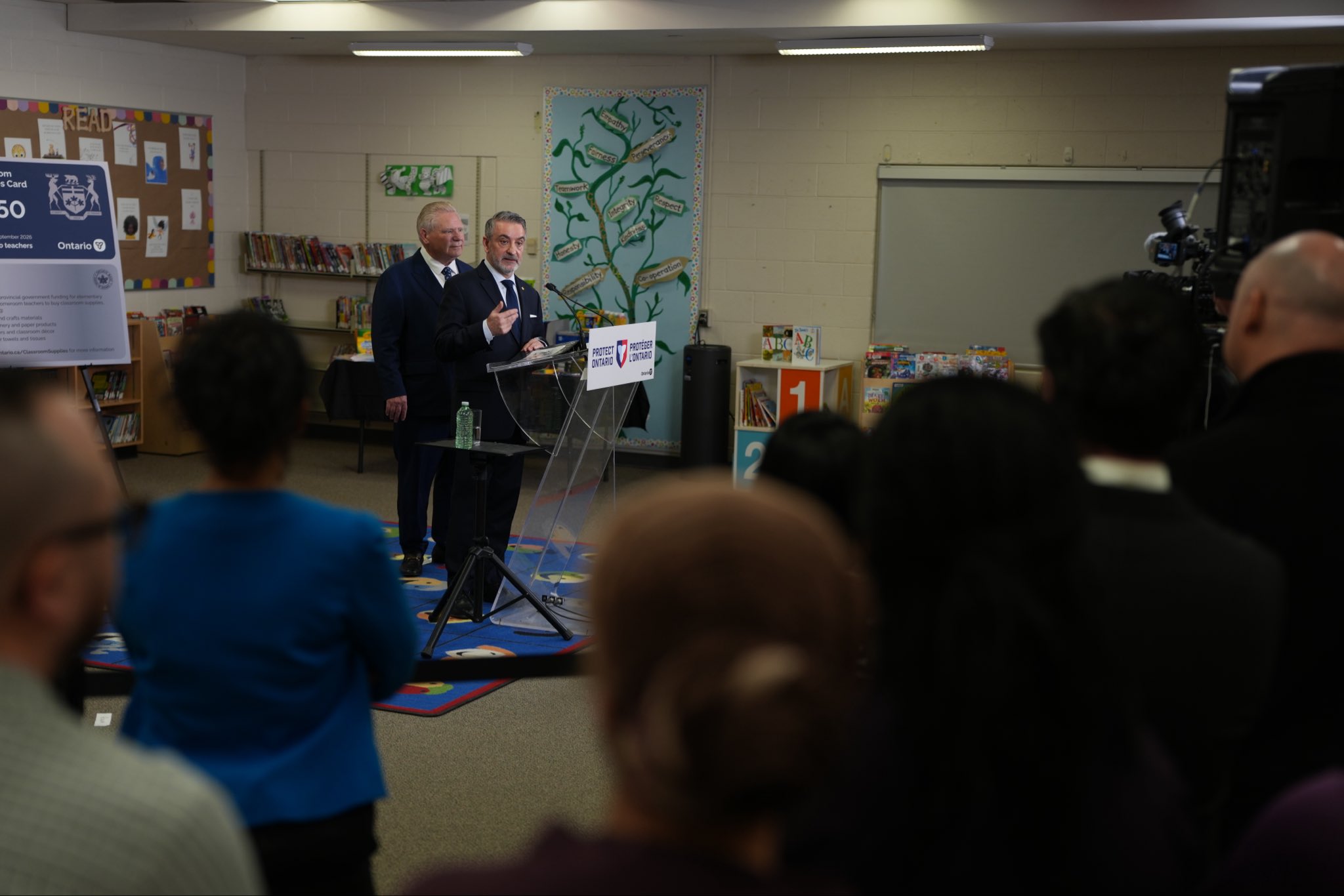
Ford and Calandra make an announcement at a Toronto school.

Doug Ford’s education minister, Paul Calandra, wants you to believe the fault for every problem lies with your locally elected school trustees, labour unions and anyone else he can point his finger at.
The reality is deep, chronic underfunding is at the heart of concerns around safety and achievement, and two million Ontario kids are paying the price for this government’s neglect of the education system.
I’m a public school trustee for the Peel District School Board, representing Ward 6 and 11 in Mississauga. Without warning, Calandra placed the board under a 14-day provisional supervision on January 28, hours before a board meeting.
Calandra made two claims for this immediate takeover: five years of deficits and the need to immediately halt the layoffs of 60 teachers. Both of his claims were false and easily disproved through publicly-available information.
Calandra then spent 5.5 fruitless weeks searching for justification for the takeover, combing through trustee expenses and consulting the integrity commissioner in an attempt to uncover wrongdoing. In the end, he reportedly asked staff to create a budget forecast without enrollment data or insight on future funding, and used this exercise to justify retaining control of the board and appointing a supervisor at a cost of $350,000-a-year. Vaguely, he claimed the board was in worse shape than he had realized, but gave no details, no context, and no clear path for trustees to return to their seats.
We never received credible justification for losing control of the board.
Historically, under supervision, trustees have seen their responsibilities reduced — but they’ve remained in their roles, supporting the communities who elected them and relaying local concerns to staff and the supervisor. Only under Calandra have trustees been outright dismissed, removing all local voice and support for families and, along with them, accountability.
This has never happened before. This is not normal.
Similarly, he took over York Catholic, adding to — in order — Thames Valley, Toronto, Toronto Catholic, Ottawa-Carleton, Dufferin-Peel Catholic, and Near North, bringing the count up to eight boards under supervision. This number of boards has never been taken over at the same time before. It isn’t normal, either. These eight boards include some of the province’s largest and represent almost 40 per cent of all publicly-funded students in Ontario. They also control some of the most valuable real estate in the province.
Calandra has made a concerted effort since becoming education minister to paint democratically-elected trustees as responsible for nearly every challenge in the system, building a case for eliminating a role that dates back to 1816 and provides a bridge between local communities and the provision of public education for their children. He has blamed trustees for operational matters beyond their control, for decisions made by staff, for EQAO — which has nothing to do with trustees — and just about anything else he can think of.
Calandra regularly points to the Brant Haldimand Norfolk Catholic District School Board’s decision to travel to Italy to purchase religious art as evidence trustees should be eliminated. While he doesn’t mention that the board is not under supervision, that decision — and yes, it was a poor one — is repeatedly used to indict every other board. He argues trustees “have failed us,” using that claim to justify the unprecedented powers granted under Bill 33, allowing him to take over school boards at his sole discretion, for virtually any reason.
I was first elected in October 2022. I’d been asked to run before, but never considered putting my name on a ballot — until I began to see underfunding impact my own children’s school.
I grew up in rural Ontario, raised by a single mom. We didn’t have much, but we had strong public schools that opened every door for me. My family wasn’t political; we didn’t talk about politics at home. But cuts to education, along with the water crisis in Walkerton during my high school years, made me realize how decisions made hours away can shape our lives, how important it is that we take an interest in the decisions our governments are making, and how vital having a strong local voice is.
There’s a saying that history doesn’t repeat, but it rhymes. And here we are again, with a provincial government making decisions that weaken accountability and strip away local voices from decision-making. Calandra insists all these takeovers are necessary to protect students from poor governance, but let's take a look at what his government has actually done with these boards so far.
In Thames Valley, they’ve doubled the board’s deficit while slashing special education supports. In Near North, parents told Calandra at a recent town hall that the government is swooping in to fix a problem of their own making. At the Toronto District School Board, the supervisor is still using the budget passed by trustees in 2025, while increasing class sizes and eliminating education pathways for students with mild intellectual disabilities. Many of these students will no longer have the chance to graduate.
At the Toronto Catholic District School Board, language programs are being shut down. Here in Peel, the supervisor’s first move was to issue layoff notices to 331 teachers, with 52 educational assistant contracts also impacted. The board is now cutting 30 per cent of special education support staff, 25 per cent of library staffing, 12 per cent of ESL/ELL staff and more.
These cuts are devastating. They will affect every school, every classroom and every student.
If trustees are the problem, why are conditions worsening at the eight boards Calandra has already taken over? If centralized control from the Ministry is the answer, why isn’t a single one of those boards in better shape than when he found it?
Those are fair questions. We should all be asking Doug Ford what his education minister is doing to our schools as support, resources, local voice and accountability are steadily stripped away.
Our kids deserve better. They can’t wait. It’s up to us to demand it.
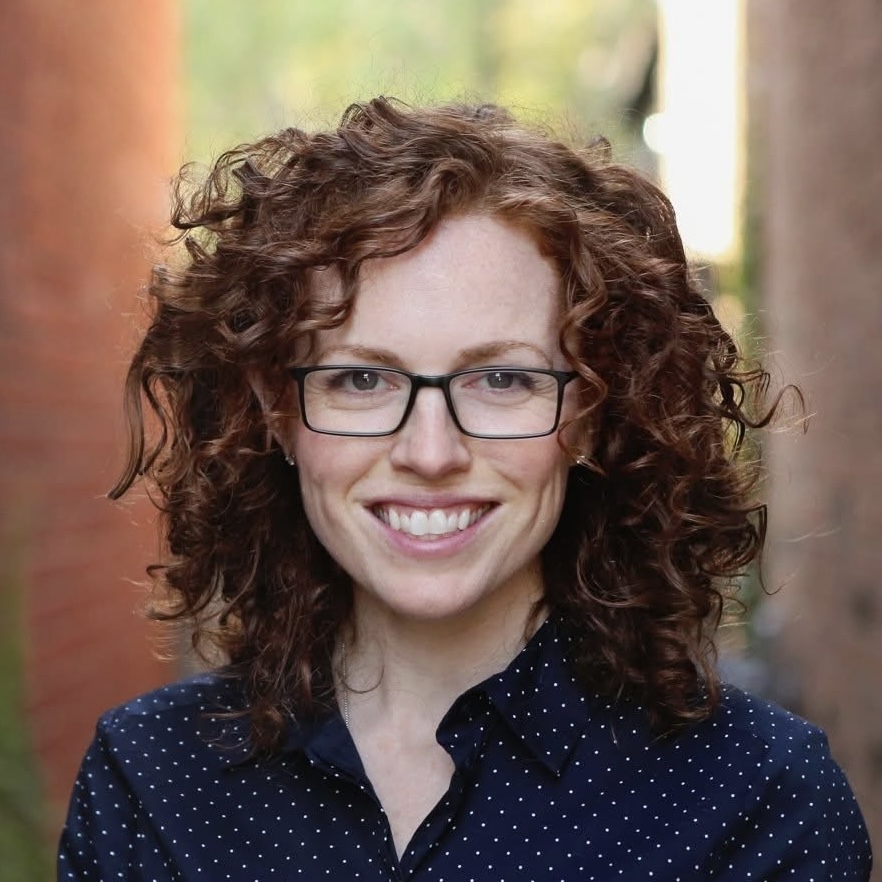
Jill Promoli is a Peel District School Board trustee and a former Liberal candidate in Mississauga-Streetsville.
Doug Ford’s education minister, Paul Calandra, wants you to believe the fault for every problem lies with your locally elected school trustees, labour unions and anyone else he can point his finger at.
The reality is deep, chronic underfunding is at the heart of concerns around safety and achievement, and two million Ontario kids are paying the price for this government’s neglect of the education system.
I’m a public school trustee for the Peel District School Board, representing Ward 6 and 11 in Mississauga. Without warning, Calandra placed the board under a 14-day provisional supervision on January 28, hours before a board meeting.
Calandra made two claims for this immediate takeover: five years of deficits and the need to immediately halt the layoffs of 60 teachers. Both of his claims were false and easily disproved through publicly-available information.
Calandra then spent 5.5 fruitless weeks searching for justification for the takeover, combing through trustee expenses and consulting the integrity commissioner in an attempt to uncover wrongdoing. In the end, he reportedly asked staff to create a budget forecast without enrollment data or insight on future funding, and used this exercise to justify retaining control of the board and appointing a supervisor at a cost of $350,000-a-year. Vaguely, he claimed the board was in worse shape than he had realized, but gave no details, no context, and no clear path for trustees to return to their seats.
We never received credible justification for losing control of the board.
Historically, under supervision, trustees have seen their responsibilities reduced — but they’ve remained in their roles, supporting the communities who elected them and relaying local concerns to staff and the supervisor. Only under Calandra have trustees been outright dismissed, removing all local voice and support for families and, along with them, accountability.
This has never happened before. This is not normal.
Similarly, he took over York Catholic, adding to — in order — Thames Valley, Toronto, Toronto Catholic, Ottawa-Carleton, Dufferin-Peel Catholic, and Near North, bringing the count up to eight boards under supervision. This number of boards has never been taken over at the same time before. It isn’t normal, either. These eight boards include some of the province’s largest and represent almost 40 per cent of all publicly-funded students in Ontario. They also control some of the most valuable real estate in the province.
Calandra has made a concerted effort since becoming education minister to paint democratically-elected trustees as responsible for nearly every challenge in the system, building a case for eliminating a role that dates back to 1816 and provides a bridge between local communities and the provision of public education for their children. He has blamed trustees for operational matters beyond their control, for decisions made by staff, for EQAO — which has nothing to do with trustees — and just about anything else he can think of.
Calandra regularly points to the Brant Haldimand Norfolk Catholic District School Board’s decision to travel to Italy to purchase religious art as evidence trustees should be eliminated. While he doesn’t mention that the board is not under supervision, that decision — and yes, it was a poor one — is repeatedly used to indict every other board. He argues trustees “have failed us,” using that claim to justify the unprecedented powers granted under Bill 33, allowing him to take over school boards at his sole discretion, for virtually any reason.
I was first elected in October 2022. I’d been asked to run before, but never considered putting my name on a ballot — until I began to see underfunding impact my own children’s school.
I grew up in rural Ontario, raised by a single mom. We didn’t have much, but we had strong public schools that opened every door for me. My family wasn’t political; we didn’t talk about politics at home. But cuts to education, along with the water crisis in Walkerton during my high school years, made me realize how decisions made hours away can shape our lives, how important it is that we take an interest in the decisions our governments are making, and how vital having a strong local voice is.
There’s a saying that history doesn’t repeat, but it rhymes. And here we are again, with a provincial government making decisions that weaken accountability and strip away local voices from decision-making. Calandra insists all these takeovers are necessary to protect students from poor governance, but let's take a look at what his government has actually done with these boards so far.
In Thames Valley, they’ve doubled the board’s deficit while slashing special education supports. In Near North, parents told Calandra at a recent town hall that the government is swooping in to fix a problem of their own making. At the Toronto District School Board, the supervisor is still using the budget passed by trustees in 2025, while increasing class sizes and eliminating education pathways for students with mild intellectual disabilities. Many of these students will no longer have the chance to graduate.
At the Toronto Catholic District School Board, language programs are being shut down. Here in Peel, the supervisor’s first move was to issue layoff notices to 331 teachers, with 52 educational assistant contracts also impacted. The board is now cutting 30 per cent of special education support staff, 25 per cent of library staffing, 12 per cent of ESL/ELL staff and more.
These cuts are devastating. They will affect every school, every classroom and every student.
If trustees are the problem, why are conditions worsening at the eight boards Calandra has already taken over? If centralized control from the Ministry is the answer, why isn’t a single one of those boards in better shape than when he found it?
Those are fair questions. We should all be asking Doug Ford what his education minister is doing to our schools as support, resources, local voice and accountability are steadily stripped away.
Our kids deserve better. They can’t wait. It’s up to us to demand it.
Jill Promoli is a Peel District School Board trustee and a former Liberal candidate in Mississauga-Streetsville.
Doug Ford’s education minister, Paul Calandra, wants you to believe the fault for every problem lies with your locally elected school trustees, labour unions and anyone else he can point his finger at.
The reality is deep, chronic underfunding is at the heart of concerns around safety and achievement, and two million Ontario kids are paying the price for this government’s neglect of the education system.
I’m a public school trustee for the Peel District School Board, representing Ward 6 and 11 in Mississauga. Without warning, Calandra placed the board under a 14-day provisional supervision on January 28, hours before a board meeting.
Calandra made two claims for this immediate takeover: five years of deficits and the need to immediately halt the layoffs of 60 teachers. Both of his claims were false and easily disproved through publicly-available information.
Calandra then spent 5.5 fruitless weeks searching for justification for the takeover, combing through trustee expenses and consulting the integrity commissioner in an attempt to uncover wrongdoing. In the end, he reportedly asked staff to create a budget forecast without enrollment data or insight on future funding, and used this exercise to justify retaining control of the board and appointing a supervisor at a cost of $350,000-a-year. Vaguely, he claimed the board was in worse shape than he had realized, but gave no details, no context, and no clear path for trustees to return to their seats.
We never received credible justification for losing control of the board.
Historically, under supervision, trustees have seen their responsibilities reduced — but they’ve remained in their roles, supporting the communities who elected them and relaying local concerns to staff and the supervisor. Only under Calandra have trustees been outright dismissed, removing all local voice and support for families and, along with them, accountability.
This has never happened before. This is not normal.
Similarly, he took over York Catholic, adding to — in order — Thames Valley, Toronto, Toronto Catholic, Ottawa-Carleton, Dufferin-Peel Catholic, and Near North, bringing the count up to eight boards under supervision. This number of boards has never been taken over at the same time before. It isn’t normal, either. These eight boards include some of the province’s largest and represent almost 40 per cent of all publicly-funded students in Ontario. They also control some of the most valuable real estate in the province.
Calandra has made a concerted effort since becoming education minister to paint democratically-elected trustees as responsible for nearly every challenge in the system, building a case for eliminating a role that dates back to 1816 and provides a bridge between local communities and the provision of public education for their children. He has blamed trustees for operational matters beyond their control, for decisions made by staff, for EQAO — which has nothing to do with trustees — and just about anything else he can think of.
Calandra regularly points to the Brant Haldimand Norfolk Catholic District School Board’s decision to travel to Italy to purchase religious art as evidence trustees should be eliminated. While he doesn’t mention that the board is not under supervision, that decision — and yes, it was a poor one — is repeatedly used to indict every other board. He argues trustees “have failed us,” using that claim to justify the unprecedented powers granted under Bill 33, allowing him to take over school boards at his sole discretion, for virtually any reason.
I was first elected in October 2022. I’d been asked to run before, but never considered putting my name on a ballot — until I began to see underfunding impact my own children’s school.
I grew up in rural Ontario, raised by a single mom. We didn’t have much, but we had strong public schools that opened every door for me. My family wasn’t political; we didn’t talk about politics at home. But cuts to education, along with the water crisis in Walkerton during my high school years, made me realize how decisions made hours away can shape our lives, how important it is that we take an interest in the decisions our governments are making, and how vital having a strong local voice is.
There’s a saying that history doesn’t repeat, but it rhymes. And here we are again, with a provincial government making decisions that weaken accountability and strip away local voices from decision-making. Calandra insists all these takeovers are necessary to protect students from poor governance, but let's take a look at what his government has actually done with these boards so far.
In Thames Valley, they’ve doubled the board’s deficit while slashing special education supports. In Near North, parents told Calandra at a recent town hall that the government is swooping in to fix a problem of their own making. At the Toronto District School Board, the supervisor is still using the budget passed by trustees in 2025, while increasing class sizes and eliminating education pathways for students with mild intellectual disabilities. Many of these students will no longer have the chance to graduate.
At the Toronto Catholic District School Board, language programs are being shut down. Here in Peel, the supervisor’s first move was to issue layoff notices to 331 teachers, with 52 educational assistant contracts also impacted. The board is now cutting 30 per cent of special education support staff, 25 per cent of library staffing, 12 per cent of ESL/ELL staff and more.
These cuts are devastating. They will affect every school, every classroom and every student.
If trustees are the problem, why are conditions worsening at the eight boards Calandra has already taken over? If centralized control from the Ministry is the answer, why isn’t a single one of those boards in better shape than when he found it?
Those are fair questions. We should all be asking Doug Ford what his education minister is doing to our schools as support, resources, local voice and accountability are steadily stripped away.
Our kids deserve better. They can’t wait. It’s up to us to demand it.
Jill Promoli is a Peel District School Board trustee and a former Liberal candidate in Mississauga-Streetsville.
Doug Ford’s education minister, Paul Calandra, wants you to believe the fault for every problem lies with your locally elected school trustees, labour unions and anyone else he can point his finger at.
The reality is deep, chronic underfunding is at the heart of concerns around safety and achievement, and two million Ontario kids are paying the price for this government’s neglect of the education system.
I’m a public school trustee for the Peel District School Board, representing Ward 6 and 11 in Mississauga. Without warning, Calandra placed the board under a 14-day provisional supervision on January 28, hours before a board meeting.
Calandra made two claims for this immediate takeover: five years of deficits and the need to immediately halt the layoffs of 60 teachers. Both of his claims were false and easily disproved through publicly-available information.
Calandra then spent 5.5 fruitless weeks searching for justification for the takeover, combing through trustee expenses and consulting the integrity commissioner in an attempt to uncover wrongdoing. In the end, he reportedly asked staff to create a budget forecast without enrollment data or insight on future funding, and used this exercise to justify retaining control of the board and appointing a supervisor at a cost of $350,000-a-year. Vaguely, he claimed the board was in worse shape than he had realized, but gave no details, no context, and no clear path for trustees to return to their seats.
We never received credible justification for losing control of the board.
Historically, under supervision, trustees have seen their responsibilities reduced — but they’ve remained in their roles, supporting the communities who elected them and relaying local concerns to staff and the supervisor. Only under Calandra have trustees been outright dismissed, removing all local voice and support for families and, along with them, accountability.
This has never happened before. This is not normal.
Similarly, he took over York Catholic, adding to — in order — Thames Valley, Toronto, Toronto Catholic, Ottawa-Carleton, Dufferin-Peel Catholic, and Near North, bringing the count up to eight boards under supervision. This number of boards has never been taken over at the same time before. It isn’t normal, either. These eight boards include some of the province’s largest and represent almost 40 per cent of all publicly-funded students in Ontario. They also control some of the most valuable real estate in the province.
Calandra has made a concerted effort since becoming education minister to paint democratically-elected trustees as responsible for nearly every challenge in the system, building a case for eliminating a role that dates back to 1816 and provides a bridge between local communities and the provision of public education for their children. He has blamed trustees for operational matters beyond their control, for decisions made by staff, for EQAO — which has nothing to do with trustees — and just about anything else he can think of.
Calandra regularly points to the Brant Haldimand Norfolk Catholic District School Board’s decision to travel to Italy to purchase religious art as evidence trustees should be eliminated. While he doesn’t mention that the board is not under supervision, that decision — and yes, it was a poor one — is repeatedly used to indict every other board. He argues trustees “have failed us,” using that claim to justify the unprecedented powers granted under Bill 33, allowing him to take over school boards at his sole discretion, for virtually any reason.
I was first elected in October 2022. I’d been asked to run before, but never considered putting my name on a ballot — until I began to see underfunding impact my own children’s school.
I grew up in rural Ontario, raised by a single mom. We didn’t have much, but we had strong public schools that opened every door for me. My family wasn’t political; we didn’t talk about politics at home. But cuts to education, along with the water crisis in Walkerton during my high school years, made me realize how decisions made hours away can shape our lives, how important it is that we take an interest in the decisions our governments are making, and how vital having a strong local voice is.
There’s a saying that history doesn’t repeat, but it rhymes. And here we are again, with a provincial government making decisions that weaken accountability and strip away local voices from decision-making. Calandra insists all these takeovers are necessary to protect students from poor governance, but let's take a look at what his government has actually done with these boards so far.
In Thames Valley, they’ve doubled the board’s deficit while slashing special education supports. In Near North, parents told Calandra at a recent town hall that the government is swooping in to fix a problem of their own making. At the Toronto District School Board, the supervisor is still using the budget passed by trustees in 2025, while increasing class sizes and eliminating education pathways for students with mild intellectual disabilities. Many of these students will no longer have the chance to graduate.
At the Toronto Catholic District School Board, language programs are being shut down. Here in Peel, the supervisor’s first move was to issue layoff notices to 331 teachers, with 52 educational assistant contracts also impacted. The board is now cutting 30 per cent of special education support staff, 25 per cent of library staffing, 12 per cent of ESL/ELL staff and more.
These cuts are devastating. They will affect every school, every classroom and every student.
If trustees are the problem, why are conditions worsening at the eight boards Calandra has already taken over? If centralized control from the Ministry is the answer, why isn’t a single one of those boards in better shape than when he found it?
Those are fair questions. We should all be asking Doug Ford what his education minister is doing to our schools as support, resources, local voice and accountability are steadily stripped away.
Our kids deserve better. They can’t wait. It’s up to us to demand it.
Jill Promoli is a Peel District School Board trustee and a former Liberal candidate in Mississauga-Streetsville.
Doug Ford’s education minister, Paul Calandra, wants you to believe the fault for every problem lies with your locally elected school trustees, labour unions and anyone else he can point his finger at.
The reality is deep, chronic underfunding is at the heart of concerns around safety and achievement, and two million Ontario kids are paying the price for this government’s neglect of the education system.
I’m a public school trustee for the Peel District School Board, representing Ward 6 and 11 in Mississauga. Without warning, Calandra placed the board under a 14-day provisional supervision on January 28, hours before a board meeting.
Calandra made two claims for this immediate takeover: five years of deficits and the need to immediately halt the layoffs of 60 teachers. Both of his claims were false and easily disproved through publicly-available information.
Calandra then spent 5.5 fruitless weeks searching for justification for the takeover, combing through trustee expenses and consulting the integrity commissioner in an attempt to uncover wrongdoing. In the end, he reportedly asked staff to create a budget forecast without enrollment data or insight on future funding, and used this exercise to justify retaining control of the board and appointing a supervisor at a cost of $350,000-a-year. Vaguely, he claimed the board was in worse shape than he had realized, but gave no details, no context, and no clear path for trustees to return to their seats.
We never received credible justification for losing control of the board.
Historically, under supervision, trustees have seen their responsibilities reduced — but they’ve remained in their roles, supporting the communities who elected them and relaying local concerns to staff and the supervisor. Only under Calandra have trustees been outright dismissed, removing all local voice and support for families and, along with them, accountability.
This has never happened before. This is not normal.
Similarly, he took over York Catholic, adding to — in order — Thames Valley, Toronto, Toronto Catholic, Ottawa-Carleton, Dufferin-Peel Catholic, and Near North, bringing the count up to eight boards under supervision. This number of boards has never been taken over at the same time before. It isn’t normal, either. These eight boards include some of the province’s largest and represent almost 40 per cent of all publicly-funded students in Ontario. They also control some of the most valuable real estate in the province.
Calandra has made a concerted effort since becoming education minister to paint democratically-elected trustees as responsible for nearly every challenge in the system, building a case for eliminating a role that dates back to 1816 and provides a bridge between local communities and the provision of public education for their children. He has blamed trustees for operational matters beyond their control, for decisions made by staff, for EQAO — which has nothing to do with trustees — and just about anything else he can think of.
Calandra regularly points to the Brant Haldimand Norfolk Catholic District School Board’s decision to travel to Italy to purchase religious art as evidence trustees should be eliminated. While he doesn’t mention that the board is not under supervision, that decision — and yes, it was a poor one — is repeatedly used to indict every other board. He argues trustees “have failed us,” using that claim to justify the unprecedented powers granted under Bill 33, allowing him to take over school boards at his sole discretion, for virtually any reason.
I was first elected in October 2022. I’d been asked to run before, but never considered putting my name on a ballot — until I began to see underfunding impact my own children’s school.
I grew up in rural Ontario, raised by a single mom. We didn’t have much, but we had strong public schools that opened every door for me. My family wasn’t political; we didn’t talk about politics at home. But cuts to education, along with the water crisis in Walkerton during my high school years, made me realize how decisions made hours away can shape our lives, how important it is that we take an interest in the decisions our governments are making, and how vital having a strong local voice is.
There’s a saying that history doesn’t repeat, but it rhymes. And here we are again, with a provincial government making decisions that weaken accountability and strip away local voices from decision-making. Calandra insists all these takeovers are necessary to protect students from poor governance, but let's take a look at what his government has actually done with these boards so far.
In Thames Valley, they’ve doubled the board’s deficit while slashing special education supports. In Near North, parents told Calandra at a recent town hall that the government is swooping in to fix a problem of their own making. At the Toronto District School Board, the supervisor is still using the budget passed by trustees in 2025, while increasing class sizes and eliminating education pathways for students with mild intellectual disabilities. Many of these students will no longer have the chance to graduate.
At the Toronto Catholic District School Board, language programs are being shut down. Here in Peel, the supervisor’s first move was to issue layoff notices to 331 teachers, with 52 educational assistant contracts also impacted. The board is now cutting 30 per cent of special education support staff, 25 per cent of library staffing, 12 per cent of ESL/ELL staff and more.
These cuts are devastating. They will affect every school, every classroom and every student.
If trustees are the problem, why are conditions worsening at the eight boards Calandra has already taken over? If centralized control from the Ministry is the answer, why isn’t a single one of those boards in better shape than when he found it?
Those are fair questions. We should all be asking Doug Ford what his education minister is doing to our schools as support, resources, local voice and accountability are steadily stripped away.
Our kids deserve better. They can’t wait. It’s up to us to demand it.
Jill Promoli is a Peel District School Board trustee and a former Liberal candidate in Mississauga-Streetsville.
Doug Ford’s education minister, Paul Calandra, wants you to believe the fault for every problem lies with your locally elected school trustees, labour unions and anyone else he can point his finger at.
The reality is deep, chronic underfunding is at the heart of concerns around safety and achievement, and two million Ontario kids are paying the price for this government’s neglect of the education system.
I’m a public school trustee for the Peel District School Board, representing Ward 6 and 11 in Mississauga. Without warning, Calandra placed the board under a 14-day provisional supervision on January 28, hours before a board meeting.
Calandra made two claims for this immediate takeover: five years of deficits and the need to immediately halt the layoffs of 60 teachers. Both of his claims were false and easily disproved through publicly-available information.
Calandra then spent 5.5 fruitless weeks searching for justification for the takeover, combing through trustee expenses and consulting the integrity commissioner in an attempt to uncover wrongdoing. In the end, he reportedly asked staff to create a budget forecast without enrollment data or insight on future funding, and used this exercise to justify retaining control of the board and appointing a supervisor at a cost of $350,000-a-year. Vaguely, he claimed the board was in worse shape than he had realized, but gave no details, no context, and no clear path for trustees to return to their seats.
We never received credible justification for losing control of the board.
Historically, under supervision, trustees have seen their responsibilities reduced — but they’ve remained in their roles, supporting the communities who elected them and relaying local concerns to staff and the supervisor. Only under Calandra have trustees been outright dismissed, removing all local voice and support for families and, along with them, accountability.
This has never happened before. This is not normal.
Similarly, he took over York Catholic, adding to — in order — Thames Valley, Toronto, Toronto Catholic, Ottawa-Carleton, Dufferin-Peel Catholic, and Near North, bringing the count up to eight boards under supervision. This number of boards has never been taken over at the same time before. It isn’t normal, either. These eight boards include some of the province’s largest and represent almost 40 per cent of all publicly-funded students in Ontario. They also control some of the most valuable real estate in the province.
Calandra has made a concerted effort since becoming education minister to paint democratically-elected trustees as responsible for nearly every challenge in the system, building a case for eliminating a role that dates back to 1816 and provides a bridge between local communities and the provision of public education for their children. He has blamed trustees for operational matters beyond their control, for decisions made by staff, for EQAO — which has nothing to do with trustees — and just about anything else he can think of.
Calandra regularly points to the Brant Haldimand Norfolk Catholic District School Board’s decision to travel to Italy to purchase religious art as evidence trustees should be eliminated. While he doesn’t mention that the board is not under supervision, that decision — and yes, it was a poor one — is repeatedly used to indict every other board. He argues trustees “have failed us,” using that claim to justify the unprecedented powers granted under Bill 33, allowing him to take over school boards at his sole discretion, for virtually any reason.
I was first elected in October 2022. I’d been asked to run before, but never considered putting my name on a ballot — until I began to see underfunding impact my own children’s school.
I grew up in rural Ontario, raised by a single mom. We didn’t have much, but we had strong public schools that opened every door for me. My family wasn’t political; we didn’t talk about politics at home. But cuts to education, along with the water crisis in Walkerton during my high school years, made me realize how decisions made hours away can shape our lives, how important it is that we take an interest in the decisions our governments are making, and how vital having a strong local voice is.
There’s a saying that history doesn’t repeat, but it rhymes. And here we are again, with a provincial government making decisions that weaken accountability and strip away local voices from decision-making. Calandra insists all these takeovers are necessary to protect students from poor governance, but let's take a look at what his government has actually done with these boards so far.
In Thames Valley, they’ve doubled the board’s deficit while slashing special education supports. In Near North, parents told Calandra at a recent town hall that the government is swooping in to fix a problem of their own making. At the Toronto District School Board, the supervisor is still using the budget passed by trustees in 2025, while increasing class sizes and eliminating education pathways for students with mild intellectual disabilities. Many of these students will no longer have the chance to graduate.
At the Toronto Catholic District School Board, language programs are being shut down. Here in Peel, the supervisor’s first move was to issue layoff notices to 331 teachers, with 52 educational assistant contracts also impacted. The board is now cutting 30 per cent of special education support staff, 25 per cent of library staffing, 12 per cent of ESL/ELL staff and more.
These cuts are devastating. They will affect every school, every classroom and every student.
If trustees are the problem, why are conditions worsening at the eight boards Calandra has already taken over? If centralized control from the Ministry is the answer, why isn’t a single one of those boards in better shape than when he found it?
Those are fair questions. We should all be asking Doug Ford what his education minister is doing to our schools as support, resources, local voice and accountability are steadily stripped away.
Our kids deserve better. They can’t wait. It’s up to us to demand it.
Jill Promoli is a Peel District School Board trustee and a former Liberal candidate in Mississauga-Streetsville.
Doug Ford’s education minister, Paul Calandra, wants you to believe the fault for every problem lies with your locally elected school trustees, labour unions and anyone else he can point his finger at.
The reality is deep, chronic underfunding is at the heart of concerns around safety and achievement, and two million Ontario kids are paying the price for this government’s neglect of the education system.
I’m a public school trustee for the Peel District School Board, representing Ward 6 and 11 in Mississauga. Without warning, Calandra placed the board under a 14-day provisional supervision on January 28, hours before a board meeting.
Calandra made two claims for this immediate takeover: five years of deficits and the need to immediately halt the layoffs of 60 teachers. Both of his claims were false and easily disproved through publicly-available information.
Calandra then spent 5.5 fruitless weeks searching for justification for the takeover, combing through trustee expenses and consulting the integrity commissioner in an attempt to uncover wrongdoing. In the end, he reportedly asked staff to create a budget forecast without enrollment data or insight on future funding, and used this exercise to justify retaining control of the board and appointing a supervisor at a cost of $350,000-a-year. Vaguely, he claimed the board was in worse shape than he had realized, but gave no details, no context, and no clear path for trustees to return to their seats.
We never received credible justification for losing control of the board.
Historically, under supervision, trustees have seen their responsibilities reduced — but they’ve remained in their roles, supporting the communities who elected them and relaying local concerns to staff and the supervisor. Only under Calandra have trustees been outright dismissed, removing all local voice and support for families and, along with them, accountability.
This has never happened before. This is not normal.
Similarly, he took over York Catholic, adding to — in order — Thames Valley, Toronto, Toronto Catholic, Ottawa-Carleton, Dufferin-Peel Catholic, and Near North, bringing the count up to eight boards under supervision. This number of boards has never been taken over at the same time before. It isn’t normal, either. These eight boards include some of the province’s largest and represent almost 40 per cent of all publicly-funded students in Ontario. They also control some of the most valuable real estate in the province.
Calandra has made a concerted effort since becoming education minister to paint democratically-elected trustees as responsible for nearly every challenge in the system, building a case for eliminating a role that dates back to 1816 and provides a bridge between local communities and the provision of public education for their children. He has blamed trustees for operational matters beyond their control, for decisions made by staff, for EQAO — which has nothing to do with trustees — and just about anything else he can think of.
Calandra regularly points to the Brant Haldimand Norfolk Catholic District School Board’s decision to travel to Italy to purchase religious art as evidence trustees should be eliminated. While he doesn’t mention that the board is not under supervision, that decision — and yes, it was a poor one — is repeatedly used to indict every other board. He argues trustees “have failed us,” using that claim to justify the unprecedented powers granted under Bill 33, allowing him to take over school boards at his sole discretion, for virtually any reason.
I was first elected in October 2022. I’d been asked to run before, but never considered putting my name on a ballot — until I began to see underfunding impact my own children’s school.
I grew up in rural Ontario, raised by a single mom. We didn’t have much, but we had strong public schools that opened every door for me. My family wasn’t political; we didn’t talk about politics at home. But cuts to education, along with the water crisis in Walkerton during my high school years, made me realize how decisions made hours away can shape our lives, how important it is that we take an interest in the decisions our governments are making, and how vital having a strong local voice is.
There’s a saying that history doesn’t repeat, but it rhymes. And here we are again, with a provincial government making decisions that weaken accountability and strip away local voices from decision-making. Calandra insists all these takeovers are necessary to protect students from poor governance, but let's take a look at what his government has actually done with these boards so far.
In Thames Valley, they’ve doubled the board’s deficit while slashing special education supports. In Near North, parents told Calandra at a recent town hall that the government is swooping in to fix a problem of their own making. At the Toronto District School Board, the supervisor is still using the budget passed by trustees in 2025, while increasing class sizes and eliminating education pathways for students with mild intellectual disabilities. Many of these students will no longer have the chance to graduate.
At the Toronto Catholic District School Board, language programs are being shut down. Here in Peel, the supervisor’s first move was to issue layoff notices to 331 teachers, with 52 educational assistant contracts also impacted. The board is now cutting 30 per cent of special education support staff, 25 per cent of library staffing, 12 per cent of ESL/ELL staff and more.
These cuts are devastating. They will affect every school, every classroom and every student.
If trustees are the problem, why are conditions worsening at the eight boards Calandra has already taken over? If centralized control from the Ministry is the answer, why isn’t a single one of those boards in better shape than when he found it?
Those are fair questions. We should all be asking Doug Ford what his education minister is doing to our schools as support, resources, local voice and accountability are steadily stripped away.
Our kids deserve better. They can’t wait. It’s up to us to demand it.
Jill Promoli is a Peel District School Board trustee and a former Liberal candidate in Mississauga-Streetsville.
Doug Ford’s education minister, Paul Calandra, wants you to believe the fault for every problem lies with your locally elected school trustees, labour unions and anyone else he can point his finger at.
The reality is deep, chronic underfunding is at the heart of concerns around safety and achievement, and two million Ontario kids are paying the price for this government’s neglect of the education system.
I’m a public school trustee for the Peel District School Board, representing Ward 6 and 11 in Mississauga. Without warning, Calandra placed the board under a 14-day provisional supervision on January 28, hours before a board meeting.
Calandra made two claims for this immediate takeover: five years of deficits and the need to immediately halt the layoffs of 60 teachers. Both of his claims were false and easily disproved through publicly-available information.
Calandra then spent 5.5 fruitless weeks searching for justification for the takeover, combing through trustee expenses and consulting the integrity commissioner in an attempt to uncover wrongdoing. In the end, he reportedly asked staff to create a budget forecast without enrollment data or insight on future funding, and used this exercise to justify retaining control of the board and appointing a supervisor at a cost of $350,000-a-year. Vaguely, he claimed the board was in worse shape than he had realized, but gave no details, no context, and no clear path for trustees to return to their seats.
We never received credible justification for losing control of the board.
Historically, under supervision, trustees have seen their responsibilities reduced — but they’ve remained in their roles, supporting the communities who elected them and relaying local concerns to staff and the supervisor. Only under Calandra have trustees been outright dismissed, removing all local voice and support for families and, along with them, accountability.
This has never happened before. This is not normal.
Similarly, he took over York Catholic, adding to — in order — Thames Valley, Toronto, Toronto Catholic, Ottawa-Carleton, Dufferin-Peel Catholic, and Near North, bringing the count up to eight boards under supervision. This number of boards has never been taken over at the same time before. It isn’t normal, either. These eight boards include some of the province’s largest and represent almost 40 per cent of all publicly-funded students in Ontario. They also control some of the most valuable real estate in the province.
Calandra has made a concerted effort since becoming education minister to paint democratically-elected trustees as responsible for nearly every challenge in the system, building a case for eliminating a role that dates back to 1816 and provides a bridge between local communities and the provision of public education for their children. He has blamed trustees for operational matters beyond their control, for decisions made by staff, for EQAO — which has nothing to do with trustees — and just about anything else he can think of.
Calandra regularly points to the Brant Haldimand Norfolk Catholic District School Board’s decision to travel to Italy to purchase religious art as evidence trustees should be eliminated. While he doesn’t mention that the board is not under supervision, that decision — and yes, it was a poor one — is repeatedly used to indict every other board. He argues trustees “have failed us,” using that claim to justify the unprecedented powers granted under Bill 33, allowing him to take over school boards at his sole discretion, for virtually any reason.
I was first elected in October 2022. I’d been asked to run before, but never considered putting my name on a ballot — until I began to see underfunding impact my own children’s school.
I grew up in rural Ontario, raised by a single mom. We didn’t have much, but we had strong public schools that opened every door for me. My family wasn’t political; we didn’t talk about politics at home. But cuts to education, along with the water crisis in Walkerton during my high school years, made me realize how decisions made hours away can shape our lives, how important it is that we take an interest in the decisions our governments are making, and how vital having a strong local voice is.
There’s a saying that history doesn’t repeat, but it rhymes. And here we are again, with a provincial government making decisions that weaken accountability and strip away local voices from decision-making. Calandra insists all these takeovers are necessary to protect students from poor governance, but let's take a look at what his government has actually done with these boards so far.
In Thames Valley, they’ve doubled the board’s deficit while slashing special education supports. In Near North, parents told Calandra at a recent town hall that the government is swooping in to fix a problem of their own making. At the Toronto District School Board, the supervisor is still using the budget passed by trustees in 2025, while increasing class sizes and eliminating education pathways for students with mild intellectual disabilities. Many of these students will no longer have the chance to graduate.
At the Toronto Catholic District School Board, language programs are being shut down. Here in Peel, the supervisor’s first move was to issue layoff notices to 331 teachers, with 52 educational assistant contracts also impacted. The board is now cutting 30 per cent of special education support staff, 25 per cent of library staffing, 12 per cent of ESL/ELL staff and more.
These cuts are devastating. They will affect every school, every classroom and every student.
If trustees are the problem, why are conditions worsening at the eight boards Calandra has already taken over? If centralized control from the Ministry is the answer, why isn’t a single one of those boards in better shape than when he found it?
Those are fair questions. We should all be asking Doug Ford what his education minister is doing to our schools as support, resources, local voice and accountability are steadily stripped away.
Our kids deserve better. They can’t wait. It’s up to us to demand it.
Jill Promoli is a Peel District School Board trustee and a former Liberal candidate in Mississauga-Streetsville.
Doug Ford’s education minister, Paul Calandra, wants you to believe the fault for every problem lies with your locally elected school trustees, labour unions and anyone else he can point his finger at.
The reality is deep, chronic underfunding is at the heart of concerns around safety and achievement, and two million Ontario kids are paying the price for this government’s neglect of the education system.
I’m a public school trustee for the Peel District School Board, representing Ward 6 and 11 in Mississauga. Without warning, Calandra placed the board under a 14-day provisional supervision on January 28, hours before a board meeting.
Calandra made two claims for this immediate takeover: five years of deficits and the need to immediately halt the layoffs of 60 teachers. Both of his claims were false and easily disproved through publicly-available information.
Calandra then spent 5.5 fruitless weeks searching for justification for the takeover, combing through trustee expenses and consulting the integrity commissioner in an attempt to uncover wrongdoing. In the end, he reportedly asked staff to create a budget forecast without enrollment data or insight on future funding, and used this exercise to justify retaining control of the board and appointing a supervisor at a cost of $350,000-a-year. Vaguely, he claimed the board was in worse shape than he had realized, but gave no details, no context, and no clear path for trustees to return to their seats.
We never received credible justification for losing control of the board.
Historically, under supervision, trustees have seen their responsibilities reduced — but they’ve remained in their roles, supporting the communities who elected them and relaying local concerns to staff and the supervisor. Only under Calandra have trustees been outright dismissed, removing all local voice and support for families and, along with them, accountability.
This has never happened before. This is not normal.
Similarly, he took over York Catholic, adding to — in order — Thames Valley, Toronto, Toronto Catholic, Ottawa-Carleton, Dufferin-Peel Catholic, and Near North, bringing the count up to eight boards under supervision. This number of boards has never been taken over at the same time before. It isn’t normal, either. These eight boards include some of the province’s largest and represent almost 40 per cent of all publicly-funded students in Ontario. They also control some of the most valuable real estate in the province.
Calandra has made a concerted effort since becoming education minister to paint democratically-elected trustees as responsible for nearly every challenge in the system, building a case for eliminating a role that dates back to 1816 and provides a bridge between local communities and the provision of public education for their children. He has blamed trustees for operational matters beyond their control, for decisions made by staff, for EQAO — which has nothing to do with trustees — and just about anything else he can think of.
Calandra regularly points to the Brant Haldimand Norfolk Catholic District School Board’s decision to travel to Italy to purchase religious art as evidence trustees should be eliminated. While he doesn’t mention that the board is not under supervision, that decision — and yes, it was a poor one — is repeatedly used to indict every other board. He argues trustees “have failed us,” using that claim to justify the unprecedented powers granted under Bill 33, allowing him to take over school boards at his sole discretion, for virtually any reason.
I was first elected in October 2022. I’d been asked to run before, but never considered putting my name on a ballot — until I began to see underfunding impact my own children’s school.
I grew up in rural Ontario, raised by a single mom. We didn’t have much, but we had strong public schools that opened every door for me. My family wasn’t political; we didn’t talk about politics at home. But cuts to education, along with the water crisis in Walkerton during my high school years, made me realize how decisions made hours away can shape our lives, how important it is that we take an interest in the decisions our governments are making, and how vital having a strong local voice is.
There’s a saying that history doesn’t repeat, but it rhymes. And here we are again, with a provincial government making decisions that weaken accountability and strip away local voices from decision-making. Calandra insists all these takeovers are necessary to protect students from poor governance, but let's take a look at what his government has actually done with these boards so far.
In Thames Valley, they’ve doubled the board’s deficit while slashing special education supports. In Near North, parents told Calandra at a recent town hall that the government is swooping in to fix a problem of their own making. At the Toronto District School Board, the supervisor is still using the budget passed by trustees in 2025, while increasing class sizes and eliminating education pathways for students with mild intellectual disabilities. Many of these students will no longer have the chance to graduate.
At the Toronto Catholic District School Board, language programs are being shut down. Here in Peel, the supervisor’s first move was to issue layoff notices to 331 teachers, with 52 educational assistant contracts also impacted. The board is now cutting 30 per cent of special education support staff, 25 per cent of library staffing, 12 per cent of ESL/ELL staff and more.
These cuts are devastating. They will affect every school, every classroom and every student.
If trustees are the problem, why are conditions worsening at the eight boards Calandra has already taken over? If centralized control from the Ministry is the answer, why isn’t a single one of those boards in better shape than when he found it?
Those are fair questions. We should all be asking Doug Ford what his education minister is doing to our schools as support, resources, local voice and accountability are steadily stripped away.
Our kids deserve better. They can’t wait. It’s up to us to demand it.
Jill Promoli is a Peel District School Board trustee and a former Liberal candidate in Mississauga-Streetsville.