
Breaking

How Carolyn Parrish found her rhythm with Doug Ford

“Working with Mr. Ford is better than fighting with Mr. Ford.”
Ahmad Elbayoumi
March 30, 2026

THE LEDE

Carolyn Parrish and Doug Ford weren’t obvious allies.

For years, Parrish had built her brand as blunt, unapologetic and willing to go her own way — and on the night she became Madame Mayor, she made clear she wasn’t about to change.

“I’m not going to read all this — it’s way too much,” said Parrish, tossing aside her prepared victory speech. No script in hand, she promised a “stronger” Peel Region, with a new mayor who can “actually get along” with the other two — and act “formidable” when making the case for funding to the Ford government.

It was a hint at a reset — and a clear dig at her predecessor, Bonnie Crombie, the then-new Liberal leader, whose relationship with Ford, as mayor, had deteriorated.

THE LEDE

Carolyn Parrish and Doug Ford weren’t obvious allies.

For years, Parrish had built her brand as blunt, unapologetic and willing to go her own way — and on the night she became Madame Mayor, she made clear she wasn’t about to change.

“I’m not going to read all this — it’s way too much,” said Parrish, tossing aside her prepared victory speech. No script in hand, she promised a “stronger” Peel Region, with a new mayor who can “actually get along” with the other two — and act “formidable” when making the case for funding to the Ford government.

It was a hint at a reset — and a clear dig at her predecessor, Bonnie Crombie, the then-new Liberal leader, whose relationship with Ford, as mayor, had deteriorated.

THE LEDE

Carolyn Parrish and Doug Ford weren’t obvious allies.

For years, Parrish had built her brand as blunt, unapologetic and willing to go her own way — and on the night she became Madame Mayor, she made clear she wasn’t about to change.

“I’m not going to read all this — it’s way too much,” said Parrish, tossing aside her prepared victory speech. No script in hand, she promised a “stronger” Peel Region, with a new mayor who can “actually get along” with the other two — and act “formidable” when making the case for funding to the Ford government.

It was a hint at a reset — and a clear dig at her predecessor, Bonnie Crombie, the then-new Liberal leader, whose relationship with Ford, as mayor, had deteriorated.

Crombie fought the Ford government over a proposed waiver of development charges. Later, the Tories abandoned a plan to break up the region — a move Crombie had championed — that would have made Mississauga, Brampton and Caledon stand-alone cities, and froze up to $32 million in cash over the city’s low housing starts.

But Parrish herself wasn’t always a fan of Ford, who she once called a “male chauvinist pig.” She urged mayors to reject his “strong mayor” powers and criticized him for “playing to the construction unions and big developers who can’t wait to destroy [the] Greenbelt.” Parrish warned voters had “accidentally elected Ford,” and pointed to what she called “unbelievable vote-buying.”

That was then.

Now, the Mississauga mayor has hit her stride with the Premier, going as far as calling herself a “hard-core Tory” provincially at Ford Fest last summer. Last week, she praised Ford as a “super-star.”

But Parrish insists the “force” and “charm” she promised on election night hasn’t gone anywhere.

“It’s a different kind of a force,” she said in a December interview. “We use logic and reason, and we work together fairly well.”

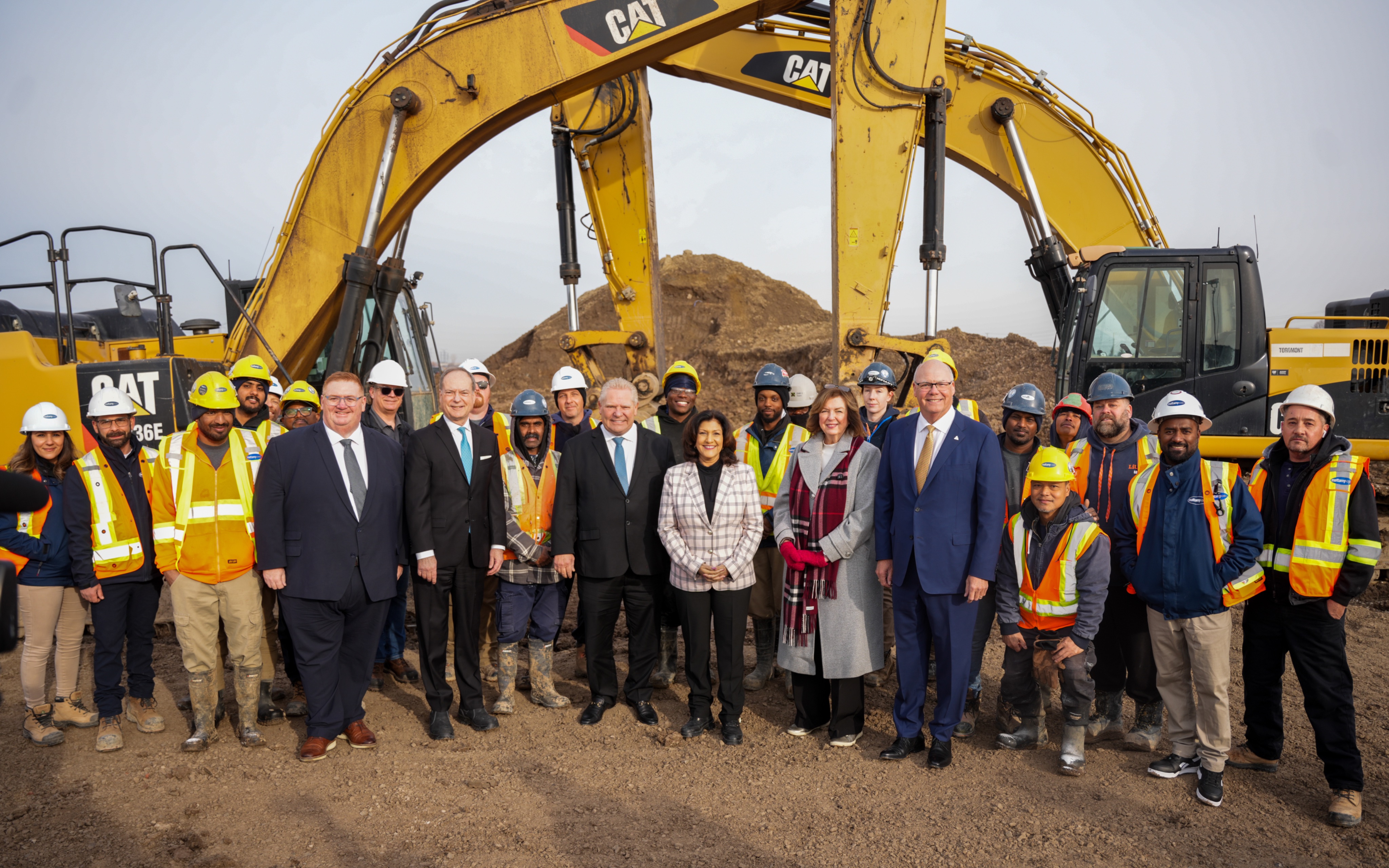
Ford and Parrish at a housing announcement in Mississauga.

What changed: It began early in her term, Parrish says, during a basement meeting at Ford’s Etobicoke home. She went in expecting something formal. Instead, she found him on his knees, wrestling with a wood stove and damp paper.

“George said, ‘Sir, go sit at the table with the rest of them. I can do this.’ He got the thing going, but Ford wasn’t focused on the meeting at all. He was watching what George was doing,” she said in an interview, speaking of George Carlson, a former councillor-turned-advisor.

Soon enough, they were all outside chopping wood.

“He said to George, ‘Do you want to hold or do you want to chop?’ George said, ‘I’ll hold.’ I thought, ‘Are you crazy? You’ll lose fingers.’ And he said, ‘No, I can let go quickly if he loses control.’ But the thing he was using to chop wood wasn’t meant for it — it was dull, the wrong shape, everything.”

For Parrish, that encounter, later coming full circle when she handed him a just-bought axe at a Mississauga Board of Trade event, stayed with her.

“He’s just a regular guy,” she said. “When you meet him face to face… you see another side of him, and I really, truly like him.”

Carlson, a friend of Parrish’s since 1985, described it as “two people who have met and become good friends.” “It’s pretty hard to dislike him when you get to know him,” he said.

But beyond the encounter, Parrish and Ford have found footing — both politically and personally.


A message from Dokainish & Company:

Ontario is building the future. Dokainish has built award-winning PMOs and delivered programs on-budget and ahead-of-schedule across the world's most demanding industries. We’re optimizing projects for nuclear, renewable energy, and infrastructure in Canada’s largest province and beyond. Learn more.


The political: Tories viewed Parrish’s win as a reset — particularly, a chance to speed up the shrinking city’s lethargic progress in home construction.

Throughout her campaign, she promised to create a panel of “reputable builders to review and speed up project approvals.” It’d give them a forum, Parrish said, to “tell us what’s working, what we need to do more of and what we can do better.” Two weeks into her term, Parrish launched that panel, including over a dozen prominent developers in the Greater Toronto Area.

At a time when politicians’ relationships with builders were under scrutiny — a result of the Ford government’s controversial decision to develop on protected Greenbelt land — Parrish was unapologetic. “I have worked with developers for thirteen years as a councillor,” she said. “I have a good working relationship with them. They’re here to make money and build developments. I’m here to get developments built.”

And that straight-shooting style is part of why Ford and Parrish click. “She is a blunt talker,” said one Progressive Conservative. “Ford has always liked those people, even when he disagrees with them.”

“What you see is what you get,” said Housing Minister Rob Flack, a Mississauga native whose father, Jim, was a superintendent who worked with Parrish at the Peel District School Board.

“There’s no hidden agenda… She’s a tough negotiator. When she knows what she wants, she goes to get it, and I like that type of person.”

Added Nina Tangri, the Associate Minister of Small Business: “She and I have worked very closely. Even when she was a councillor, I would reach out to her about things I wanted to see at council, and she worked hard to make that happen. Now that she’s mayor, she’s worked very closely with our government. The relationship has been phenomenal.”

Her view: “Working with Mr. Ford is better than fighting with Mr. Ford,” Parrish argued. “He’s a businessman, so he sees the logic.”

The Mississauga mayor, who opposed the proposed regional split, pointed to Bill 45 as proof. “We engineered the changes we wanted. We asked for them, and they put them into legislation at our request,” she added. “It’s not like they came in and dictated it.”

Alvin Tedjo, who placed second to Parrish in the last mayoral contest and is weighing another run, said the province sees Mississauga as a willing partner, especially on housing.

“We’ve made a number of changes over the last couple of years that have been led by the mayor — especially on housing — and I think that’s great. We’ve shown a strong example,” Tedjo said.

But the councillor questioned whether Parrish’s approach is delivering. “It’s certainly more polite, more cordial, less adversarial. Has that given us the results we’ve been looking for? I wouldn’t say so,” he added. “We’re still waiting on the province to do its part on a number of issues.”

“For better or worse, the province has a lot of influence. They’ll say the right things, like downloading, and then claw it back and say, ‘Let’s do it a year from now.’ It hasn’t necessarily borne as much fruit as you’d expect.”

That is now being tested. Parrish is turning up the heat for a reset of the region’s police service, calling the 50-year-old funding formula “patently unfair.” Last week, she urged the Ford government to switch to a per-capita, crime-based formula or let Mississauga go it alone.

Parrish, who quit the police board in protest of a 23.3 per cent budget increase, is frank.

“We’re paying 62 per cent, they’re paying 38,” she said, arguing Mississauga subsidized the neighbouring city by $133 million in 2024 alone.

The imbalance, Parrish said, is borne out in policing demand. “They are not under-served. You turn on the TV… something’s happened in Brampton,” she added, pointing to more frequent calls and fewer low-demand neighbourhoods in Brampton compared to her city. “It only makes sense they get more police service.”

She added:Patrick Brown doesn’t mind [the formula], because he knows we’re paying the lion’s share of it.”

For now, the Ford government isn’t moving. Sources say no change to Peel Regional Police is planned. Even so, Parrish is holding out hope they’ll come around. “I suggested that 12 per cent has to be moved to Brampton. If you do four per cent this year, four next year and four in the last year, it will give them time to cope with a 50-50 split. They’re very receptive to that. They haven’t done it, but I’m very optimistic.”

But the politics are tricky. Any change to the funding model would drive up costs — and likely taxes — in Brampton, a potential headache for Ford in a fast-growing city where the Tories hold all five seats.

Parrish says it’s a two-way street. “I could have said it’s the Ford government not fixing your taxes,” she said. “We didn’t. We blamed the police board, which is the source of the 23.3 per cent — and got that message out.”

Carlson described it as a balancing act. “Good mayors always have to keep one kick in reserve,” he said. “You can’t be too in awe of federal or provincial leaders. Once in a while, you have to be able to say, ‘No, you’re full of it, and this is going to hurt our city.’ You have to keep a bit of spark.”

Zoom out, and the relationship is transactional. As Parrish put it: “You do something for me, I’ll do something for you.”

Consider the hospital: The province asked the city to pay a share toward the new Peter Gilgan Mississauga Hospital — and council was divided. Some argued hospitals fall under provincial jurisdiction, and the city shouldn’t be on the hook. $450 million “was more than a handshake could handle,” Parrish said.

She won over council by linking the city’s cheque to what Mississauga could claw back from the Ford government in return. She recalled: “I said, if we can get some of the things we need that will help us pay that, would you be interested in giving it a shot?”

They were. Council ultimately backed a $390 million contribution, funded through a “built-in” one per cent levy. But it’s a straight trade, Parrish warned: “If we get everything we need out of the province, it’ll stick. A new council can take another vote and say, ‘No, we’re not giving it.’”


A message from Dokainish & Company:

We optimize the interplay between people, processes, technology, and data, while integrating AI, to ensure capital projects finish on time and on budget. Learn more.


The personal: Parrish and Ford are now staring down a common opponent in Bonnie Crombie, the city’s former mayor. Crombie is “seriously considering” a run back to Mississauga City Hall.

Parrish and Crombie have a long history. Crombie, backed by Hazel McCallion, who had previously clashed with Parrish over a real estate deal involving her son, defeated the mayor in a heated council contest. Parrish took aim at Crombie, calling “her blondness,” a failed federal parliamentarian and a “woman under orders” by McCallion.

“I kind of feel sorry for her,” Parrish said of Crombie’s potential run. “You didn’t leave because you loved the job. You went to do something bigger. Okay, I get that — but to come back? It’s like me running for the school board again. The fact that she’s even considering it kind of makes me feel sorry.”

Ford, meanwhile, had a testy relationship with Crombie, both as mayor and later as Liberal leader.

“Parrish has been a reliable and cooperative partner at a time when the Premier needs allies in the 905,” said a second Progressive Conservative source, who spoke on condition of anonymity. “Crombie, on the other hand, spent two years as Liberal leader trying to defeat him. That is not something Ford forgets easily.”

For his part, the Premier has pledged to help stop Crombie. “It was an absolute disaster under Bonnie Crombie,” he said last week in Mississauga. “I never get involved in municipal elections, but I will send an army down here to make sure I support Mayor Parrish. So, what I say to Bonnie Crombie: bring it on, let’s go, we’re ready.”

But the comment didn’t sit well with some. Mississauga’s ex-city manager, Janice Baker, called it “utter non-sense and disrespectful to the 5,000+ city employees who worked hard every day to deliver services.”

“While she had her idiosyncrasies, like all politicians, we worked well together,” she added, urging Ford to “stick to provincial politics and let the residents of Mississauga make their own choices.”

But privately: Sources say Ford has already signalled to his Mississauga caucus that he’d like to see them rally behind Parrish should the ex-mayor enter the race. (“We would love to,” one said.)

Crombie declined to comment, but a source close to her said Ford “should be focused on his own job rather than his own personal vendettas.”

David Valentin, principal at Liaison Strategies, says the race would be “competitive.” “We saw that Mayor Parrish’s numbers are more or less where they were during the by-election,” he said. “The Ontario Liberal Party didn’t win any seats in Mississauga, but they did get a sizable amount of votes in the city. Bonnie Crombie’s percentage doesn’t mirror that exactly, but it’s around the same.”

Does Ford’s endorsement help Parrish — or hurt her? Valentin said it’s a question of how far the Premier goes.

“If he’s making more and more public statements to support her, that’s one thing. If they’re appearing together during the campaign, that’s another thing. If all he’s doing is sending donors and volunteers to help her, that’s quite another thing,” he said, suggesting the impact will hinge on how visible — and how aggressive — Ford’s involvement is.

Valentin warned: “The Tories won the 905 vote, but what we are seeing now is a dramatic softening of their support in the 905. Will they have recovered in the 905 by the time the municipal cycle has come around — or will they see further deterioration? The Premier’s endorsement is only as good as his own personal approvals.”

But Parrish isn’t too worried. “Every election is a challenge, and you can never take any election for granted,” said Parrish, who, at 79, is set to seek one final term. “I’ve been doing this for 40 years, so I’m not too worried.”


Thank you for reading POLICORNER. Are you in the caucus, the council chamber — or somewhere in between? Reach out and I’ll keep you anonymous, just like those sources you’re curious about.

THE LEDE

Carolyn Parrish and Doug Ford weren’t obvious allies.

For years, Parrish had built her brand as blunt, unapologetic and willing to go her own way — and on the night she became Madame Mayor, she made clear she wasn’t about to change.

“I’m not going to read all this — it’s way too much,” said Parrish, tossing aside her prepared victory speech. No script in hand, she promised a “stronger” Peel Region, with a new mayor who can “actually get along” with the other two — and act “formidable” when making the case for funding to the Ford government.

It was a hint at a reset — and a clear dig at her predecessor, Bonnie Crombie, the then-new Liberal leader, whose relationship with Ford, as mayor, had deteriorated.

Crombie fought the Ford government over a proposed waiver of development charges. Later, the Tories abandoned a plan to break up the region — a move Crombie had championed — that would have made Mississauga, Brampton and Caledon stand-alone cities, and froze up to $32 million in cash over the city’s low housing starts.

But Parrish herself wasn’t always a fan of Ford, who she once called a “male chauvinist pig.” She urged mayors to reject his “strong mayor” powers and criticized him for “playing to the construction unions and big developers who can’t wait to destroy [the] Greenbelt.” Parrish warned voters had “accidentally elected Ford,” and pointed to what she called “unbelievable vote-buying.”

That was then.

Now, the Mississauga mayor has hit her stride with the Premier, going as far as calling herself a “hard-core Tory” provincially at Ford Fest last summer. Last week, she praised Ford as a “super-star.”

But Parrish insists the “force” and “charm” she promised on election night hasn’t gone anywhere.

“It’s a different kind of a force,” she said in a December interview. “We use logic and reason, and we work together fairly well.”

Ford and Parrish at a housing announcement in Mississauga.

What changed: It began early in her term, Parrish says, during a basement meeting at Ford’s Etobicoke home. She went in expecting something formal. Instead, she found him on his knees, wrestling with a wood stove and damp paper.

“George said, ‘Sir, go sit at the table with the rest of them. I can do this.’ He got the thing going, but Ford wasn’t focused on the meeting at all. He was watching what George was doing,” she said in an interview, speaking of George Carlson, a former councillor-turned-advisor.

Soon enough, they were all outside chopping wood.

“He said to George, ‘Do you want to hold or do you want to chop?’ George said, ‘I’ll hold.’ I thought, ‘Are you crazy? You’ll lose fingers.’ And he said, ‘No, I can let go quickly if he loses control.’ But the thing he was using to chop wood wasn’t meant for it — it was dull, the wrong shape, everything.”

For Parrish, that encounter, later coming full circle when she handed him a just-bought axe at a Mississauga Board of Trade event, stayed with her.

“He’s just a regular guy,” she said. “When you meet him face to face… you see another side of him, and I really, truly like him.”

Carlson, a friend of Parrish’s since 1985, described it as “two people who have met and become good friends.” “It’s pretty hard to dislike him when you get to know him,” he said.

But beyond the encounter, Parrish and Ford have found footing — both politically and personally.


A message from Dokainish & Company:

Ontario is building the future. Dokainish has built award-winning PMOs and delivered programs on-budget and ahead-of-schedule across the world's most demanding industries. We’re optimizing projects for nuclear, renewable energy, and infrastructure in Canada’s largest province and beyond. Learn more.


The political: Tories viewed Parrish’s win as a reset — particularly, a chance to speed up the shrinking city’s lethargic progress in home construction.

Throughout her campaign, she promised to create a panel of “reputable builders to review and speed up project approvals.” It’d give them a forum, Parrish said, to “tell us what’s working, what we need to do more of and what we can do better.” Two weeks into her term, Parrish launched that panel, including over a dozen prominent developers in the Greater Toronto Area.

At a time when politicians’ relationships with builders were under scrutiny — a result of the Ford government’s controversial decision to develop on protected Greenbelt land — Parrish was unapologetic. “I have worked with developers for thirteen years as a councillor,” she said. “I have a good working relationship with them. They’re here to make money and build developments. I’m here to get developments built.”

And that straight-shooting style is part of why Ford and Parrish click. “She is a blunt talker,” said one Progressive Conservative. “Ford has always liked those people, even when he disagrees with them.”

“What you see is what you get,” said Housing Minister Rob Flack, a Mississauga native whose father, Jim, was a superintendent who worked with Parrish at the Peel District School Board.

“There’s no hidden agenda… She’s a tough negotiator. When she knows what she wants, she goes to get it, and I like that type of person.”

Added Nina Tangri, the Associate Minister of Small Business: “She and I have worked very closely. Even when she was a councillor, I would reach out to her about things I wanted to see at council, and she worked hard to make that happen. Now that she’s mayor, she’s worked very closely with our government. The relationship has been phenomenal.”

Her view: “Working with Mr. Ford is better than fighting with Mr. Ford,” Parrish argued. “He’s a businessman, so he sees the logic.”

The Mississauga mayor, who opposed the proposed regional split, pointed to Bill 45 as proof. “We engineered the changes we wanted. We asked for them, and they put them into legislation at our request,” she added. “It’s not like they came in and dictated it.”

Alvin Tedjo, who placed second to Parrish in the last mayoral contest and is weighing another run, said the province sees Mississauga as a willing partner, especially on housing.

“We’ve made a number of changes over the last couple of years that have been led by the mayor — especially on housing — and I think that’s great. We’ve shown a strong example,” Tedjo said.

But the councillor questioned whether Parrish’s approach is delivering. “It’s certainly more polite, more cordial, less adversarial. Has that given us the results we’ve been looking for? I wouldn’t say so,” he added. “We’re still waiting on the province to do its part on a number of issues.”

“For better or worse, the province has a lot of influence. They’ll say the right things, like downloading, and then claw it back and say, ‘Let’s do it a year from now.’ It hasn’t necessarily borne as much fruit as you’d expect.”

That is now being tested. Parrish is turning up the heat for a reset of the region’s police service, calling the 50-year-old funding formula “patently unfair.” Last week, she urged the Ford government to switch to a per-capita, crime-based formula or let Mississauga go it alone.

Parrish, who quit the police board in protest of a 23.3 per cent budget increase, is frank.

“We’re paying 62 per cent, they’re paying 38,” she said, arguing Mississauga subsidized the neighbouring city by $133 million in 2024 alone.

The imbalance, Parrish said, is borne out in policing demand. “They are not under-served. You turn on the TV… something’s happened in Brampton,” she added, pointing to more frequent calls and fewer low-demand neighbourhoods in Brampton compared to her city. “It only makes sense they get more police service.”

She added:Patrick Brown doesn’t mind [the formula], because he knows we’re paying the lion’s share of it.”

For now, the Ford government isn’t moving. Sources say no change to Peel Regional Police is planned. Even so, Parrish is holding out hope they’ll come around. “I suggested that 12 per cent has to be moved to Brampton. If you do four per cent this year, four next year and four in the last year, it will give them time to cope with a 50-50 split. They’re very receptive to that. They haven’t done it, but I’m very optimistic.”

But the politics are tricky. Any change to the funding model would drive up costs — and likely taxes — in Brampton, a potential headache for Ford in a fast-growing city where the Tories hold all five seats.

Parrish says it’s a two-way street. “I could have said it’s the Ford government not fixing your taxes,” she said. “We didn’t. We blamed the police board, which is the source of the 23.3 per cent — and got that message out.”

Carlson described it as a balancing act. “Good mayors always have to keep one kick in reserve,” he said. “You can’t be too in awe of federal or provincial leaders. Once in a while, you have to be able to say, ‘No, you’re full of it, and this is going to hurt our city.’ You have to keep a bit of spark.”

Zoom out, and the relationship is transactional. As Parrish put it: “You do something for me, I’ll do something for you.”

Consider the hospital: The province asked the city to pay a share toward the new Peter Gilgan Mississauga Hospital — and council was divided. Some argued hospitals fall under provincial jurisdiction, and the city shouldn’t be on the hook. $450 million “was more than a handshake could handle,” Parrish said.

She won over council by linking the city’s cheque to what Mississauga could claw back from the Ford government in return. She recalled: “I said, if we can get some of the things we need that will help us pay that, would you be interested in giving it a shot?”

They were. Council ultimately backed a $390 million contribution, funded through a “built-in” one per cent levy. But it’s a straight trade, Parrish warned: “If we get everything we need out of the province, it’ll stick. A new council can take another vote and say, ‘No, we’re not giving it.’”


A message from Dokainish & Company:

We optimize the interplay between people, processes, technology, and data, while integrating AI, to ensure capital projects finish on time and on budget. Learn more.


The personal: Parrish and Ford are now staring down a common opponent in Bonnie Crombie, the city’s former mayor. Crombie is “seriously considering” a run back to Mississauga City Hall.

Parrish and Crombie have a long history. Crombie, backed by Hazel McCallion, who had previously clashed with Parrish over a real estate deal involving her son, defeated the mayor in a heated council contest. Parrish took aim at Crombie, calling “her blondness,” a failed federal parliamentarian and a “woman under orders” by McCallion.

“I kind of feel sorry for her,” Parrish said of Crombie’s potential run. “You didn’t leave because you loved the job. You went to do something bigger. Okay, I get that — but to come back? It’s like me running for the school board again. The fact that she’s even considering it kind of makes me feel sorry.”

Ford, meanwhile, had a testy relationship with Crombie, both as mayor and later as Liberal leader.

“Parrish has been a reliable and cooperative partner at a time when the Premier needs allies in the 905,” said a second Progressive Conservative source, who spoke on condition of anonymity. “Crombie, on the other hand, spent two years as Liberal leader trying to defeat him. That is not something Ford forgets easily.”

For his part, the Premier has pledged to help stop Crombie. “It was an absolute disaster under Bonnie Crombie,” he said last week in Mississauga. “I never get involved in municipal elections, but I will send an army down here to make sure I support Mayor Parrish. So, what I say to Bonnie Crombie: bring it on, let’s go, we’re ready.”

But the comment didn’t sit well with some. Mississauga’s ex-city manager, Janice Baker, called it “utter non-sense and disrespectful to the 5,000+ city employees who worked hard every day to deliver services.”

“While she had her idiosyncrasies, like all politicians, we worked well together,” she added, urging Ford to “stick to provincial politics and let the residents of Mississauga make their own choices.”

But privately: Sources say Ford has already signalled to his Mississauga caucus that he’d like to see them rally behind Parrish should the ex-mayor enter the race. (“We would love to,” one said.)

Crombie declined to comment, but a source close to her said Ford “should be focused on his own job rather than his own personal vendettas.”

David Valentin, principal at Liaison Strategies, says the race would be “competitive.” “We saw that Mayor Parrish’s numbers are more or less where they were during the by-election,” he said. “The Ontario Liberal Party didn’t win any seats in Mississauga, but they did get a sizable amount of votes in the city. Bonnie Crombie’s percentage doesn’t mirror that exactly, but it’s around the same.”

Does Ford’s endorsement help Parrish — or hurt her? Valentin said it’s a question of how far the Premier goes.

“If he’s making more and more public statements to support her, that’s one thing. If they’re appearing together during the campaign, that’s another thing. If all he’s doing is sending donors and volunteers to help her, that’s quite another thing,” he said, suggesting the impact will hinge on how visible — and how aggressive — Ford’s involvement is.

Valentin warned: “The Tories won the 905 vote, but what we are seeing now is a dramatic softening of their support in the 905. Will they have recovered in the 905 by the time the municipal cycle has come around — or will they see further deterioration? The Premier’s endorsement is only as good as his own personal approvals.”

But Parrish isn’t too worried. “Every election is a challenge, and you can never take any election for granted,” said Parrish, who, at 79, is set to seek one final term. “I’ve been doing this for 40 years, so I’m not too worried.”


Thank you for reading POLICORNER. Are you in the caucus, the council chamber — or somewhere in between? Reach out and I’ll keep you anonymous, just like those sources you’re curious about.

THE LEDE

Carolyn Parrish and Doug Ford weren’t obvious allies.

For years, Parrish had built her brand as blunt, unapologetic and willing to go her own way — and on the night she became Madame Mayor, she made clear she wasn’t about to change.

“I’m not going to read all this — it’s way too much,” said Parrish, tossing aside her prepared victory speech. No script in hand, she promised a “stronger” Peel Region, with a new mayor who can “actually get along” with the other two — and act “formidable” when making the case for funding to the Ford government.

It was a hint at a reset — and a clear dig at her predecessor, Bonnie Crombie, the then-new Liberal leader, whose relationship with Ford, as mayor, had deteriorated.

Crombie fought the Ford government over a proposed waiver of development charges. Later, the Tories abandoned a plan to break up the region — a move Crombie had championed — that would have made Mississauga, Brampton and Caledon stand-alone cities, and froze up to $32 million in cash over the city’s low housing starts.

But Parrish herself wasn’t always a fan of Ford, who she once called a “male chauvinist pig.” She urged mayors to reject his “strong mayor” powers and criticized him for “playing to the construction unions and big developers who can’t wait to destroy [the] Greenbelt.” Parrish warned voters had “accidentally elected Ford,” and pointed to what she called “unbelievable vote-buying.”

That was then.

Now, the Mississauga mayor has hit her stride with the Premier, going as far as calling herself a “hard-core Tory” provincially at Ford Fest last summer. Last week, she praised Ford as a “super-star.”

But Parrish insists the “force” and “charm” she promised on election night hasn’t gone anywhere.

“It’s a different kind of a force,” she said in a December interview. “We use logic and reason, and we work together fairly well.”

Ford and Parrish at a housing announcement in Mississauga.

What changed: It began early in her term, Parrish says, during a basement meeting at Ford’s Etobicoke home. She went in expecting something formal. Instead, she found him on his knees, wrestling with a wood stove and damp paper.

“George said, ‘Sir, go sit at the table with the rest of them. I can do this.’ He got the thing going, but Ford wasn’t focused on the meeting at all. He was watching what George was doing,” she said in an interview, speaking of George Carlson, a former councillor-turned-advisor.

Soon enough, they were all outside chopping wood.

“He said to George, ‘Do you want to hold or do you want to chop?’ George said, ‘I’ll hold.’ I thought, ‘Are you crazy? You’ll lose fingers.’ And he said, ‘No, I can let go quickly if he loses control.’ But the thing he was using to chop wood wasn’t meant for it — it was dull, the wrong shape, everything.”

For Parrish, that encounter, later coming full circle when she handed him a just-bought axe at a Mississauga Board of Trade event, stayed with her.

“He’s just a regular guy,” she said. “When you meet him face to face… you see another side of him, and I really, truly like him.”

Carlson, a friend of Parrish’s since 1985, described it as “two people who have met and become good friends.” “It’s pretty hard to dislike him when you get to know him,” he said.

But beyond the encounter, Parrish and Ford have found footing — both politically and personally.


A message from Dokainish & Company:

Ontario is building the future. Dokainish has built award-winning PMOs and delivered programs on-budget and ahead-of-schedule across the world's most demanding industries. We’re optimizing projects for nuclear, renewable energy, and infrastructure in Canada’s largest province and beyond. Learn more.


The political: Tories viewed Parrish’s win as a reset — particularly, a chance to speed up the shrinking city’s lethargic progress in home construction.

Throughout her campaign, she promised to create a panel of “reputable builders to review and speed up project approvals.” It’d give them a forum, Parrish said, to “tell us what’s working, what we need to do more of and what we can do better.” Two weeks into her term, Parrish launched that panel, including over a dozen prominent developers in the Greater Toronto Area.

At a time when politicians’ relationships with builders were under scrutiny — a result of the Ford government’s controversial decision to develop on protected Greenbelt land — Parrish was unapologetic. “I have worked with developers for thirteen years as a councillor,” she said. “I have a good working relationship with them. They’re here to make money and build developments. I’m here to get developments built.”

And that straight-shooting style is part of why Ford and Parrish click. “She is a blunt talker,” said one Progressive Conservative. “Ford has always liked those people, even when he disagrees with them.”

“What you see is what you get,” said Housing Minister Rob Flack, a Mississauga native whose father, Jim, was a superintendent who worked with Parrish at the Peel District School Board.

“There’s no hidden agenda… She’s a tough negotiator. When she knows what she wants, she goes to get it, and I like that type of person.”

Added Nina Tangri, the Associate Minister of Small Business: “She and I have worked very closely. Even when she was a councillor, I would reach out to her about things I wanted to see at council, and she worked hard to make that happen. Now that she’s mayor, she’s worked very closely with our government. The relationship has been phenomenal.”

Her view: “Working with Mr. Ford is better than fighting with Mr. Ford,” Parrish argued. “He’s a businessman, so he sees the logic.”

The Mississauga mayor, who opposed the proposed regional split, pointed to Bill 45 as proof. “We engineered the changes we wanted. We asked for them, and they put them into legislation at our request,” she added. “It’s not like they came in and dictated it.”

Alvin Tedjo, who placed second to Parrish in the last mayoral contest and is weighing another run, said the province sees Mississauga as a willing partner, especially on housing.

“We’ve made a number of changes over the last couple of years that have been led by the mayor — especially on housing — and I think that’s great. We’ve shown a strong example,” Tedjo said.

But the councillor questioned whether Parrish’s approach is delivering. “It’s certainly more polite, more cordial, less adversarial. Has that given us the results we’ve been looking for? I wouldn’t say so,” he added. “We’re still waiting on the province to do its part on a number of issues.”

“For better or worse, the province has a lot of influence. They’ll say the right things, like downloading, and then claw it back and say, ‘Let’s do it a year from now.’ It hasn’t necessarily borne as much fruit as you’d expect.”

That is now being tested. Parrish is turning up the heat for a reset of the region’s police service, calling the 50-year-old funding formula “patently unfair.” Last week, she urged the Ford government to switch to a per-capita, crime-based formula or let Mississauga go it alone.

Parrish, who quit the police board in protest of a 23.3 per cent budget increase, is frank.

“We’re paying 62 per cent, they’re paying 38,” she said, arguing Mississauga subsidized the neighbouring city by $133 million in 2024 alone.

The imbalance, Parrish said, is borne out in policing demand. “They are not under-served. You turn on the TV… something’s happened in Brampton,” she added, pointing to more frequent calls and fewer low-demand neighbourhoods in Brampton compared to her city. “It only makes sense they get more police service.”

She added:Patrick Brown doesn’t mind [the formula], because he knows we’re paying the lion’s share of it.”

For now, the Ford government isn’t moving. Sources say no change to Peel Regional Police is planned. Even so, Parrish is holding out hope they’ll come around. “I suggested that 12 per cent has to be moved to Brampton. If you do four per cent this year, four next year and four in the last year, it will give them time to cope with a 50-50 split. They’re very receptive to that. They haven’t done it, but I’m very optimistic.”

But the politics are tricky. Any change to the funding model would drive up costs — and likely taxes — in Brampton, a potential headache for Ford in a fast-growing city where the Tories hold all five seats.

Parrish says it’s a two-way street. “I could have said it’s the Ford government not fixing your taxes,” she said. “We didn’t. We blamed the police board, which is the source of the 23.3 per cent — and got that message out.”

Carlson described it as a balancing act. “Good mayors always have to keep one kick in reserve,” he said. “You can’t be too in awe of federal or provincial leaders. Once in a while, you have to be able to say, ‘No, you’re full of it, and this is going to hurt our city.’ You have to keep a bit of spark.”

Zoom out, and the relationship is transactional. As Parrish put it: “You do something for me, I’ll do something for you.”

Consider the hospital: The province asked the city to pay a share toward the new Peter Gilgan Mississauga Hospital — and council was divided. Some argued hospitals fall under provincial jurisdiction, and the city shouldn’t be on the hook. $450 million “was more than a handshake could handle,” Parrish said.

She won over council by linking the city’s cheque to what Mississauga could claw back from the Ford government in return. She recalled: “I said, if we can get some of the things we need that will help us pay that, would you be interested in giving it a shot?”

They were. Council ultimately backed a $390 million contribution, funded through a “built-in” one per cent levy. But it’s a straight trade, Parrish warned: “If we get everything we need out of the province, it’ll stick. A new council can take another vote and say, ‘No, we’re not giving it.’”


A message from Dokainish & Company:

We optimize the interplay between people, processes, technology, and data, while integrating AI, to ensure capital projects finish on time and on budget. Learn more.


The personal: Parrish and Ford are now staring down a common opponent in Bonnie Crombie, the city’s former mayor. Crombie is “seriously considering” a run back to Mississauga City Hall.

Parrish and Crombie have a long history. Crombie, backed by Hazel McCallion, who had previously clashed with Parrish over a real estate deal involving her son, defeated the mayor in a heated council contest. Parrish took aim at Crombie, calling “her blondness,” a failed federal parliamentarian and a “woman under orders” by McCallion.

“I kind of feel sorry for her,” Parrish said of Crombie’s potential run. “You didn’t leave because you loved the job. You went to do something bigger. Okay, I get that — but to come back? It’s like me running for the school board again. The fact that she’s even considering it kind of makes me feel sorry.”

Ford, meanwhile, had a testy relationship with Crombie, both as mayor and later as Liberal leader.

“Parrish has been a reliable and cooperative partner at a time when the Premier needs allies in the 905,” said a second Progressive Conservative source, who spoke on condition of anonymity. “Crombie, on the other hand, spent two years as Liberal leader trying to defeat him. That is not something Ford forgets easily.”

For his part, the Premier has pledged to help stop Crombie. “It was an absolute disaster under Bonnie Crombie,” he said last week in Mississauga. “I never get involved in municipal elections, but I will send an army down here to make sure I support Mayor Parrish. So, what I say to Bonnie Crombie: bring it on, let’s go, we’re ready.”

But the comment didn’t sit well with some. Mississauga’s ex-city manager, Janice Baker, called it “utter non-sense and disrespectful to the 5,000+ city employees who worked hard every day to deliver services.”

“While she had her idiosyncrasies, like all politicians, we worked well together,” she added, urging Ford to “stick to provincial politics and let the residents of Mississauga make their own choices.”

But privately: Sources say Ford has already signalled to his Mississauga caucus that he’d like to see them rally behind Parrish should the ex-mayor enter the race. (“We would love to,” one said.)

Crombie declined to comment, but a source close to her said Ford “should be focused on his own job rather than his own personal vendettas.”

David Valentin, principal at Liaison Strategies, says the race would be “competitive.” “We saw that Mayor Parrish’s numbers are more or less where they were during the by-election,” he said. “The Ontario Liberal Party didn’t win any seats in Mississauga, but they did get a sizable amount of votes in the city. Bonnie Crombie’s percentage doesn’t mirror that exactly, but it’s around the same.”

Does Ford’s endorsement help Parrish — or hurt her? Valentin said it’s a question of how far the Premier goes.

“If he’s making more and more public statements to support her, that’s one thing. If they’re appearing together during the campaign, that’s another thing. If all he’s doing is sending donors and volunteers to help her, that’s quite another thing,” he said, suggesting the impact will hinge on how visible — and how aggressive — Ford’s involvement is.

Valentin warned: “The Tories won the 905 vote, but what we are seeing now is a dramatic softening of their support in the 905. Will they have recovered in the 905 by the time the municipal cycle has come around — or will they see further deterioration? The Premier’s endorsement is only as good as his own personal approvals.”

But Parrish isn’t too worried. “Every election is a challenge, and you can never take any election for granted,” said Parrish, who, at 79, is set to seek one final term. “I’ve been doing this for 40 years, so I’m not too worried.”


Thank you for reading POLICORNER. Are you in the caucus, the council chamber — or somewhere in between? Reach out and I’ll keep you anonymous, just like those sources you’re curious about.

THE LEDE

Carolyn Parrish and Doug Ford weren’t obvious allies.

For years, Parrish had built her brand as blunt, unapologetic and willing to go her own way — and on the night she became Madame Mayor, she made clear she wasn’t about to change.

“I’m not going to read all this — it’s way too much,” said Parrish, tossing aside her prepared victory speech. No script in hand, she promised a “stronger” Peel Region, with a new mayor who can “actually get along” with the other two — and act “formidable” when making the case for funding to the Ford government.

It was a hint at a reset — and a clear dig at her predecessor, Bonnie Crombie, the then-new Liberal leader, whose relationship with Ford, as mayor, had deteriorated.

Crombie fought the Ford government over a proposed waiver of development charges. Later, the Tories abandoned a plan to break up the region — a move Crombie had championed — that would have made Mississauga, Brampton and Caledon stand-alone cities, and froze up to $32 million in cash over the city’s low housing starts.

But Parrish herself wasn’t always a fan of Ford, who she once called a “male chauvinist pig.” She urged mayors to reject his “strong mayor” powers and criticized him for “playing to the construction unions and big developers who can’t wait to destroy [the] Greenbelt.” Parrish warned voters had “accidentally elected Ford,” and pointed to what she called “unbelievable vote-buying.”

That was then.

Now, the Mississauga mayor has hit her stride with the Premier, going as far as calling herself a “hard-core Tory” provincially at Ford Fest last summer. Last week, she praised Ford as a “super-star.”

But Parrish insists the “force” and “charm” she promised on election night hasn’t gone anywhere.

“It’s a different kind of a force,” she said in a December interview. “We use logic and reason, and we work together fairly well.”

Ford and Parrish at a housing announcement in Mississauga.

What changed: It began early in her term, Parrish says, during a basement meeting at Ford’s Etobicoke home. She went in expecting something formal. Instead, she found him on his knees, wrestling with a wood stove and damp paper.

“George said, ‘Sir, go sit at the table with the rest of them. I can do this.’ He got the thing going, but Ford wasn’t focused on the meeting at all. He was watching what George was doing,” she said in an interview, speaking of George Carlson, a former councillor-turned-advisor.

Soon enough, they were all outside chopping wood.

“He said to George, ‘Do you want to hold or do you want to chop?’ George said, ‘I’ll hold.’ I thought, ‘Are you crazy? You’ll lose fingers.’ And he said, ‘No, I can let go quickly if he loses control.’ But the thing he was using to chop wood wasn’t meant for it — it was dull, the wrong shape, everything.”

For Parrish, that encounter, later coming full circle when she handed him a just-bought axe at a Mississauga Board of Trade event, stayed with her.

“He’s just a regular guy,” she said. “When you meet him face to face… you see another side of him, and I really, truly like him.”

Carlson, a friend of Parrish’s since 1985, described it as “two people who have met and become good friends.” “It’s pretty hard to dislike him when you get to know him,” he said.

But beyond the encounter, Parrish and Ford have found footing — both politically and personally.


A message from Dokainish & Company:

Ontario is building the future. Dokainish has built award-winning PMOs and delivered programs on-budget and ahead-of-schedule across the world's most demanding industries. We’re optimizing projects for nuclear, renewable energy, and infrastructure in Canada’s largest province and beyond. Learn more.


The political: Tories viewed Parrish’s win as a reset — particularly, a chance to speed up the shrinking city’s lethargic progress in home construction.

Throughout her campaign, she promised to create a panel of “reputable builders to review and speed up project approvals.” It’d give them a forum, Parrish said, to “tell us what’s working, what we need to do more of and what we can do better.” Two weeks into her term, Parrish launched that panel, including over a dozen prominent developers in the Greater Toronto Area.

At a time when politicians’ relationships with builders were under scrutiny — a result of the Ford government’s controversial decision to develop on protected Greenbelt land — Parrish was unapologetic. “I have worked with developers for thirteen years as a councillor,” she said. “I have a good working relationship with them. They’re here to make money and build developments. I’m here to get developments built.”

And that straight-shooting style is part of why Ford and Parrish click. “She is a blunt talker,” said one Progressive Conservative. “Ford has always liked those people, even when he disagrees with them.”

“What you see is what you get,” said Housing Minister Rob Flack, a Mississauga native whose father, Jim, was a superintendent who worked with Parrish at the Peel District School Board.

“There’s no hidden agenda… She’s a tough negotiator. When she knows what she wants, she goes to get it, and I like that type of person.”

Added Nina Tangri, the Associate Minister of Small Business: “She and I have worked very closely. Even when she was a councillor, I would reach out to her about things I wanted to see at council, and she worked hard to make that happen. Now that she’s mayor, she’s worked very closely with our government. The relationship has been phenomenal.”

Her view: “Working with Mr. Ford is better than fighting with Mr. Ford,” Parrish argued. “He’s a businessman, so he sees the logic.”

The Mississauga mayor, who opposed the proposed regional split, pointed to Bill 45 as proof. “We engineered the changes we wanted. We asked for them, and they put them into legislation at our request,” she added. “It’s not like they came in and dictated it.”

Alvin Tedjo, who placed second to Parrish in the last mayoral contest and is weighing another run, said the province sees Mississauga as a willing partner, especially on housing.

“We’ve made a number of changes over the last couple of years that have been led by the mayor — especially on housing — and I think that’s great. We’ve shown a strong example,” Tedjo said.

But the councillor questioned whether Parrish’s approach is delivering. “It’s certainly more polite, more cordial, less adversarial. Has that given us the results we’ve been looking for? I wouldn’t say so,” he added. “We’re still waiting on the province to do its part on a number of issues.”

“For better or worse, the province has a lot of influence. They’ll say the right things, like downloading, and then claw it back and say, ‘Let’s do it a year from now.’ It hasn’t necessarily borne as much fruit as you’d expect.”

That is now being tested. Parrish is turning up the heat for a reset of the region’s police service, calling the 50-year-old funding formula “patently unfair.” Last week, she urged the Ford government to switch to a per-capita, crime-based formula or let Mississauga go it alone.

Parrish, who quit the police board in protest of a 23.3 per cent budget increase, is frank.

“We’re paying 62 per cent, they’re paying 38,” she said, arguing Mississauga subsidized the neighbouring city by $133 million in 2024 alone.

The imbalance, Parrish said, is borne out in policing demand. “They are not under-served. You turn on the TV… something’s happened in Brampton,” she added, pointing to more frequent calls and fewer low-demand neighbourhoods in Brampton compared to her city. “It only makes sense they get more police service.”

She added:Patrick Brown doesn’t mind [the formula], because he knows we’re paying the lion’s share of it.”

For now, the Ford government isn’t moving. Sources say no change to Peel Regional Police is planned. Even so, Parrish is holding out hope they’ll come around. “I suggested that 12 per cent has to be moved to Brampton. If you do four per cent this year, four next year and four in the last year, it will give them time to cope with a 50-50 split. They’re very receptive to that. They haven’t done it, but I’m very optimistic.”

But the politics are tricky. Any change to the funding model would drive up costs — and likely taxes — in Brampton, a potential headache for Ford in a fast-growing city where the Tories hold all five seats.

Parrish says it’s a two-way street. “I could have said it’s the Ford government not fixing your taxes,” she said. “We didn’t. We blamed the police board, which is the source of the 23.3 per cent — and got that message out.”

Carlson described it as a balancing act. “Good mayors always have to keep one kick in reserve,” he said. “You can’t be too in awe of federal or provincial leaders. Once in a while, you have to be able to say, ‘No, you’re full of it, and this is going to hurt our city.’ You have to keep a bit of spark.”

Zoom out, and the relationship is transactional. As Parrish put it: “You do something for me, I’ll do something for you.”

Consider the hospital: The province asked the city to pay a share toward the new Peter Gilgan Mississauga Hospital — and council was divided. Some argued hospitals fall under provincial jurisdiction, and the city shouldn’t be on the hook. $450 million “was more than a handshake could handle,” Parrish said.

She won over council by linking the city’s cheque to what Mississauga could claw back from the Ford government in return. She recalled: “I said, if we can get some of the things we need that will help us pay that, would you be interested in giving it a shot?”

They were. Council ultimately backed a $390 million contribution, funded through a “built-in” one per cent levy. But it’s a straight trade, Parrish warned: “If we get everything we need out of the province, it’ll stick. A new council can take another vote and say, ‘No, we’re not giving it.’”


A message from Dokainish & Company:

We optimize the interplay between people, processes, technology, and data, while integrating AI, to ensure capital projects finish on time and on budget. Learn more.


The personal: Parrish and Ford are now staring down a common opponent in Bonnie Crombie, the city’s former mayor. Crombie is “seriously considering” a run back to Mississauga City Hall.

Parrish and Crombie have a long history. Crombie, backed by Hazel McCallion, who had previously clashed with Parrish over a real estate deal involving her son, defeated the mayor in a heated council contest. Parrish took aim at Crombie, calling “her blondness,” a failed federal parliamentarian and a “woman under orders” by McCallion.

“I kind of feel sorry for her,” Parrish said of Crombie’s potential run. “You didn’t leave because you loved the job. You went to do something bigger. Okay, I get that — but to come back? It’s like me running for the school board again. The fact that she’s even considering it kind of makes me feel sorry.”

Ford, meanwhile, had a testy relationship with Crombie, both as mayor and later as Liberal leader.

“Parrish has been a reliable and cooperative partner at a time when the Premier needs allies in the 905,” said a second Progressive Conservative source, who spoke on condition of anonymity. “Crombie, on the other hand, spent two years as Liberal leader trying to defeat him. That is not something Ford forgets easily.”

For his part, the Premier has pledged to help stop Crombie. “It was an absolute disaster under Bonnie Crombie,” he said last week in Mississauga. “I never get involved in municipal elections, but I will send an army down here to make sure I support Mayor Parrish. So, what I say to Bonnie Crombie: bring it on, let’s go, we’re ready.”

But the comment didn’t sit well with some. Mississauga’s ex-city manager, Janice Baker, called it “utter non-sense and disrespectful to the 5,000+ city employees who worked hard every day to deliver services.”

“While she had her idiosyncrasies, like all politicians, we worked well together,” she added, urging Ford to “stick to provincial politics and let the residents of Mississauga make their own choices.”

But privately: Sources say Ford has already signalled to his Mississauga caucus that he’d like to see them rally behind Parrish should the ex-mayor enter the race. (“We would love to,” one said.)

Crombie declined to comment, but a source close to her said Ford “should be focused on his own job rather than his own personal vendettas.”

David Valentin, principal at Liaison Strategies, says the race would be “competitive.” “We saw that Mayor Parrish’s numbers are more or less where they were during the by-election,” he said. “The Ontario Liberal Party didn’t win any seats in Mississauga, but they did get a sizable amount of votes in the city. Bonnie Crombie’s percentage doesn’t mirror that exactly, but it’s around the same.”

Does Ford’s endorsement help Parrish — or hurt her? Valentin said it’s a question of how far the Premier goes.

“If he’s making more and more public statements to support her, that’s one thing. If they’re appearing together during the campaign, that’s another thing. If all he’s doing is sending donors and volunteers to help her, that’s quite another thing,” he said, suggesting the impact will hinge on how visible — and how aggressive — Ford’s involvement is.

Valentin warned: “The Tories won the 905 vote, but what we are seeing now is a dramatic softening of their support in the 905. Will they have recovered in the 905 by the time the municipal cycle has come around — or will they see further deterioration? The Premier’s endorsement is only as good as his own personal approvals.”

But Parrish isn’t too worried. “Every election is a challenge, and you can never take any election for granted,” said Parrish, who, at 79, is set to seek one final term. “I’ve been doing this for 40 years, so I’m not too worried.”


Thank you for reading POLICORNER. Are you in the caucus, the council chamber — or somewhere in between? Reach out and I’ll keep you anonymous, just like those sources you’re curious about.

THE LEDE

Carolyn Parrish and Doug Ford weren’t obvious allies.

For years, Parrish had built her brand as blunt, unapologetic and willing to go her own way — and on the night she became Madame Mayor, she made clear she wasn’t about to change.

“I’m not going to read all this — it’s way too much,” said Parrish, tossing aside her prepared victory speech. No script in hand, she promised a “stronger” Peel Region, with a new mayor who can “actually get along” with the other two — and act “formidable” when making the case for funding to the Ford government.

It was a hint at a reset — and a clear dig at her predecessor, Bonnie Crombie, the then-new Liberal leader, whose relationship with Ford, as mayor, had deteriorated.

Crombie fought the Ford government over a proposed waiver of development charges. Later, the Tories abandoned a plan to break up the region — a move Crombie had championed — that would have made Mississauga, Brampton and Caledon stand-alone cities, and froze up to $32 million in cash over the city’s low housing starts.

But Parrish herself wasn’t always a fan of Ford, who she once called a “male chauvinist pig.” She urged mayors to reject his “strong mayor” powers and criticized him for “playing to the construction unions and big developers who can’t wait to destroy [the] Greenbelt.” Parrish warned voters had “accidentally elected Ford,” and pointed to what she called “unbelievable vote-buying.”

That was then.

Now, the Mississauga mayor has hit her stride with the Premier, going as far as calling herself a “hard-core Tory” provincially at Ford Fest last summer. Last week, she praised Ford as a “super-star.”

But Parrish insists the “force” and “charm” she promised on election night hasn’t gone anywhere.

“It’s a different kind of a force,” she said in a December interview. “We use logic and reason, and we work together fairly well.”

Ford and Parrish at a housing announcement in Mississauga.

What changed: It began early in her term, Parrish says, during a basement meeting at Ford’s Etobicoke home. She went in expecting something formal. Instead, she found him on his knees, wrestling with a wood stove and damp paper.

“George said, ‘Sir, go sit at the table with the rest of them. I can do this.’ He got the thing going, but Ford wasn’t focused on the meeting at all. He was watching what George was doing,” she said in an interview, speaking of George Carlson, a former councillor-turned-advisor.

Soon enough, they were all outside chopping wood.

“He said to George, ‘Do you want to hold or do you want to chop?’ George said, ‘I’ll hold.’ I thought, ‘Are you crazy? You’ll lose fingers.’ And he said, ‘No, I can let go quickly if he loses control.’ But the thing he was using to chop wood wasn’t meant for it — it was dull, the wrong shape, everything.”

For Parrish, that encounter, later coming full circle when she handed him a just-bought axe at a Mississauga Board of Trade event, stayed with her.

“He’s just a regular guy,” she said. “When you meet him face to face… you see another side of him, and I really, truly like him.”

Carlson, a friend of Parrish’s since 1985, described it as “two people who have met and become good friends.” “It’s pretty hard to dislike him when you get to know him,” he said.

But beyond the encounter, Parrish and Ford have found footing — both politically and personally.


A message from Dokainish & Company:

Ontario is building the future. Dokainish has built award-winning PMOs and delivered programs on-budget and ahead-of-schedule across the world's most demanding industries. We’re optimizing projects for nuclear, renewable energy, and infrastructure in Canada’s largest province and beyond. Learn more.


The political: Tories viewed Parrish’s win as a reset — particularly, a chance to speed up the shrinking city’s lethargic progress in home construction.

Throughout her campaign, she promised to create a panel of “reputable builders to review and speed up project approvals.” It’d give them a forum, Parrish said, to “tell us what’s working, what we need to do more of and what we can do better.” Two weeks into her term, Parrish launched that panel, including over a dozen prominent developers in the Greater Toronto Area.

At a time when politicians’ relationships with builders were under scrutiny — a result of the Ford government’s controversial decision to develop on protected Greenbelt land — Parrish was unapologetic. “I have worked with developers for thirteen years as a councillor,” she said. “I have a good working relationship with them. They’re here to make money and build developments. I’m here to get developments built.”

And that straight-shooting style is part of why Ford and Parrish click. “She is a blunt talker,” said one Progressive Conservative. “Ford has always liked those people, even when he disagrees with them.”

“What you see is what you get,” said Housing Minister Rob Flack, a Mississauga native whose father, Jim, was a superintendent who worked with Parrish at the Peel District School Board.

“There’s no hidden agenda… She’s a tough negotiator. When she knows what she wants, she goes to get it, and I like that type of person.”

Added Nina Tangri, the Associate Minister of Small Business: “She and I have worked very closely. Even when she was a councillor, I would reach out to her about things I wanted to see at council, and she worked hard to make that happen. Now that she’s mayor, she’s worked very closely with our government. The relationship has been phenomenal.”

Her view: “Working with Mr. Ford is better than fighting with Mr. Ford,” Parrish argued. “He’s a businessman, so he sees the logic.”

The Mississauga mayor, who opposed the proposed regional split, pointed to Bill 45 as proof. “We engineered the changes we wanted. We asked for them, and they put them into legislation at our request,” she added. “It’s not like they came in and dictated it.”

Alvin Tedjo, who placed second to Parrish in the last mayoral contest and is weighing another run, said the province sees Mississauga as a willing partner, especially on housing.

“We’ve made a number of changes over the last couple of years that have been led by the mayor — especially on housing — and I think that’s great. We’ve shown a strong example,” Tedjo said.

But the councillor questioned whether Parrish’s approach is delivering. “It’s certainly more polite, more cordial, less adversarial. Has that given us the results we’ve been looking for? I wouldn’t say so,” he added. “We’re still waiting on the province to do its part on a number of issues.”

“For better or worse, the province has a lot of influence. They’ll say the right things, like downloading, and then claw it back and say, ‘Let’s do it a year from now.’ It hasn’t necessarily borne as much fruit as you’d expect.”

That is now being tested. Parrish is turning up the heat for a reset of the region’s police service, calling the 50-year-old funding formula “patently unfair.” Last week, she urged the Ford government to switch to a per-capita, crime-based formula or let Mississauga go it alone.

Parrish, who quit the police board in protest of a 23.3 per cent budget increase, is frank.

“We’re paying 62 per cent, they’re paying 38,” she said, arguing Mississauga subsidized the neighbouring city by $133 million in 2024 alone.

The imbalance, Parrish said, is borne out in policing demand. “They are not under-served. You turn on the TV… something’s happened in Brampton,” she added, pointing to more frequent calls and fewer low-demand neighbourhoods in Brampton compared to her city. “It only makes sense they get more police service.”

She added:Patrick Brown doesn’t mind [the formula], because he knows we’re paying the lion’s share of it.”

For now, the Ford government isn’t moving. Sources say no change to Peel Regional Police is planned. Even so, Parrish is holding out hope they’ll come around. “I suggested that 12 per cent has to be moved to Brampton. If you do four per cent this year, four next year and four in the last year, it will give them time to cope with a 50-50 split. They’re very receptive to that. They haven’t done it, but I’m very optimistic.”

But the politics are tricky. Any change to the funding model would drive up costs — and likely taxes — in Brampton, a potential headache for Ford in a fast-growing city where the Tories hold all five seats.

Parrish says it’s a two-way street. “I could have said it’s the Ford government not fixing your taxes,” she said. “We didn’t. We blamed the police board, which is the source of the 23.3 per cent — and got that message out.”

Carlson described it as a balancing act. “Good mayors always have to keep one kick in reserve,” he said. “You can’t be too in awe of federal or provincial leaders. Once in a while, you have to be able to say, ‘No, you’re full of it, and this is going to hurt our city.’ You have to keep a bit of spark.”

Zoom out, and the relationship is transactional. As Parrish put it: “You do something for me, I’ll do something for you.”

Consider the hospital: The province asked the city to pay a share toward the new Peter Gilgan Mississauga Hospital — and council was divided. Some argued hospitals fall under provincial jurisdiction, and the city shouldn’t be on the hook. $450 million “was more than a handshake could handle,” Parrish said.

She won over council by linking the city’s cheque to what Mississauga could claw back from the Ford government in return. She recalled: “I said, if we can get some of the things we need that will help us pay that, would you be interested in giving it a shot?”

They were. Council ultimately backed a $390 million contribution, funded through a “built-in” one per cent levy. But it’s a straight trade, Parrish warned: “If we get everything we need out of the province, it’ll stick. A new council can take another vote and say, ‘No, we’re not giving it.’”


A message from Dokainish & Company:

We optimize the interplay between people, processes, technology, and data, while integrating AI, to ensure capital projects finish on time and on budget. Learn more.


The personal: Parrish and Ford are now staring down a common opponent in Bonnie Crombie, the city’s former mayor. Crombie is “seriously considering” a run back to Mississauga City Hall.

Parrish and Crombie have a long history. Crombie, backed by Hazel McCallion, who had previously clashed with Parrish over a real estate deal involving her son, defeated the mayor in a heated council contest. Parrish took aim at Crombie, calling “her blondness,” a failed federal parliamentarian and a “woman under orders” by McCallion.

“I kind of feel sorry for her,” Parrish said of Crombie’s potential run. “You didn’t leave because you loved the job. You went to do something bigger. Okay, I get that — but to come back? It’s like me running for the school board again. The fact that she’s even considering it kind of makes me feel sorry.”

Ford, meanwhile, had a testy relationship with Crombie, both as mayor and later as Liberal leader.

“Parrish has been a reliable and cooperative partner at a time when the Premier needs allies in the 905,” said a second Progressive Conservative source, who spoke on condition of anonymity. “Crombie, on the other hand, spent two years as Liberal leader trying to defeat him. That is not something Ford forgets easily.”

For his part, the Premier has pledged to help stop Crombie. “It was an absolute disaster under Bonnie Crombie,” he said last week in Mississauga. “I never get involved in municipal elections, but I will send an army down here to make sure I support Mayor Parrish. So, what I say to Bonnie Crombie: bring it on, let’s go, we’re ready.”

But the comment didn’t sit well with some. Mississauga’s ex-city manager, Janice Baker, called it “utter non-sense and disrespectful to the 5,000+ city employees who worked hard every day to deliver services.”

“While she had her idiosyncrasies, like all politicians, we worked well together,” she added, urging Ford to “stick to provincial politics and let the residents of Mississauga make their own choices.”

But privately: Sources say Ford has already signalled to his Mississauga caucus that he’d like to see them rally behind Parrish should the ex-mayor enter the race. (“We would love to,” one said.)

Crombie declined to comment, but a source close to her said Ford “should be focused on his own job rather than his own personal vendettas.”

David Valentin, principal at Liaison Strategies, says the race would be “competitive.” “We saw that Mayor Parrish’s numbers are more or less where they were during the by-election,” he said. “The Ontario Liberal Party didn’t win any seats in Mississauga, but they did get a sizable amount of votes in the city. Bonnie Crombie’s percentage doesn’t mirror that exactly, but it’s around the same.”

Does Ford’s endorsement help Parrish — or hurt her? Valentin said it’s a question of how far the Premier goes.

“If he’s making more and more public statements to support her, that’s one thing. If they’re appearing together during the campaign, that’s another thing. If all he’s doing is sending donors and volunteers to help her, that’s quite another thing,” he said, suggesting the impact will hinge on how visible — and how aggressive — Ford’s involvement is.

Valentin warned: “The Tories won the 905 vote, but what we are seeing now is a dramatic softening of their support in the 905. Will they have recovered in the 905 by the time the municipal cycle has come around — or will they see further deterioration? The Premier’s endorsement is only as good as his own personal approvals.”

But Parrish isn’t too worried. “Every election is a challenge, and you can never take any election for granted,” said Parrish, who, at 79, is set to seek one final term. “I’ve been doing this for 40 years, so I’m not too worried.”


Thank you for reading POLICORNER. Are you in the caucus, the council chamber — or somewhere in between? Reach out and I’ll keep you anonymous, just like those sources you’re curious about.

THE LEDE

Carolyn Parrish and Doug Ford weren’t obvious allies.

For years, Parrish had built her brand as blunt, unapologetic and willing to go her own way — and on the night she became Madame Mayor, she made clear she wasn’t about to change.

“I’m not going to read all this — it’s way too much,” said Parrish, tossing aside her prepared victory speech. No script in hand, she promised a “stronger” Peel Region, with a new mayor who can “actually get along” with the other two — and act “formidable” when making the case for funding to the Ford government.

It was a hint at a reset — and a clear dig at her predecessor, Bonnie Crombie, the then-new Liberal leader, whose relationship with Ford, as mayor, had deteriorated.

Crombie fought the Ford government over a proposed waiver of development charges. Later, the Tories abandoned a plan to break up the region — a move Crombie had championed — that would have made Mississauga, Brampton and Caledon stand-alone cities, and froze up to $32 million in cash over the city’s low housing starts.

But Parrish herself wasn’t always a fan of Ford, who she once called a “male chauvinist pig.” She urged mayors to reject his “strong mayor” powers and criticized him for “playing to the construction unions and big developers who can’t wait to destroy [the] Greenbelt.” Parrish warned voters had “accidentally elected Ford,” and pointed to what she called “unbelievable vote-buying.”

That was then.

Now, the Mississauga mayor has hit her stride with the Premier, going as far as calling herself a “hard-core Tory” provincially at Ford Fest last summer. Last week, she praised Ford as a “super-star.”

But Parrish insists the “force” and “charm” she promised on election night hasn’t gone anywhere.

“It’s a different kind of a force,” she said in a December interview. “We use logic and reason, and we work together fairly well.”

Ford and Parrish at a housing announcement in Mississauga.

What changed: It began early in her term, Parrish says, during a basement meeting at Ford’s Etobicoke home. She went in expecting something formal. Instead, she found him on his knees, wrestling with a wood stove and damp paper.

“George said, ‘Sir, go sit at the table with the rest of them. I can do this.’ He got the thing going, but Ford wasn’t focused on the meeting at all. He was watching what George was doing,” she said in an interview, speaking of George Carlson, a former councillor-turned-advisor.

Soon enough, they were all outside chopping wood.

“He said to George, ‘Do you want to hold or do you want to chop?’ George said, ‘I’ll hold.’ I thought, ‘Are you crazy? You’ll lose fingers.’ And he said, ‘No, I can let go quickly if he loses control.’ But the thing he was using to chop wood wasn’t meant for it — it was dull, the wrong shape, everything.”

For Parrish, that encounter, later coming full circle when she handed him a just-bought axe at a Mississauga Board of Trade event, stayed with her.

“He’s just a regular guy,” she said. “When you meet him face to face… you see another side of him, and I really, truly like him.”

Carlson, a friend of Parrish’s since 1985, described it as “two people who have met and become good friends.” “It’s pretty hard to dislike him when you get to know him,” he said.

But beyond the encounter, Parrish and Ford have found footing — both politically and personally.


A message from Dokainish & Company:

Ontario is building the future. Dokainish has built award-winning PMOs and delivered programs on-budget and ahead-of-schedule across the world's most demanding industries. We’re optimizing projects for nuclear, renewable energy, and infrastructure in Canada’s largest province and beyond. Learn more.


The political: Tories viewed Parrish’s win as a reset — particularly, a chance to speed up the shrinking city’s lethargic progress in home construction.

Throughout her campaign, she promised to create a panel of “reputable builders to review and speed up project approvals.” It’d give them a forum, Parrish said, to “tell us what’s working, what we need to do more of and what we can do better.” Two weeks into her term, Parrish launched that panel, including over a dozen prominent developers in the Greater Toronto Area.

At a time when politicians’ relationships with builders were under scrutiny — a result of the Ford government’s controversial decision to develop on protected Greenbelt land — Parrish was unapologetic. “I have worked with developers for thirteen years as a councillor,” she said. “I have a good working relationship with them. They’re here to make money and build developments. I’m here to get developments built.”

And that straight-shooting style is part of why Ford and Parrish click. “She is a blunt talker,” said one Progressive Conservative. “Ford has always liked those people, even when he disagrees with them.”

“What you see is what you get,” said Housing Minister Rob Flack, a Mississauga native whose father, Jim, was a superintendent who worked with Parrish at the Peel District School Board.

“There’s no hidden agenda… She’s a tough negotiator. When she knows what she wants, she goes to get it, and I like that type of person.”

Added Nina Tangri, the Associate Minister of Small Business: “She and I have worked very closely. Even when she was a councillor, I would reach out to her about things I wanted to see at council, and she worked hard to make that happen. Now that she’s mayor, she’s worked very closely with our government. The relationship has been phenomenal.”

Her view: “Working with Mr. Ford is better than fighting with Mr. Ford,” Parrish argued. “He’s a businessman, so he sees the logic.”

The Mississauga mayor, who opposed the proposed regional split, pointed to Bill 45 as proof. “We engineered the changes we wanted. We asked for them, and they put them into legislation at our request,” she added. “It’s not like they came in and dictated it.”

Alvin Tedjo, who placed second to Parrish in the last mayoral contest and is weighing another run, said the province sees Mississauga as a willing partner, especially on housing.

“We’ve made a number of changes over the last couple of years that have been led by the mayor — especially on housing — and I think that’s great. We’ve shown a strong example,” Tedjo said.

But the councillor questioned whether Parrish’s approach is delivering. “It’s certainly more polite, more cordial, less adversarial. Has that given us the results we’ve been looking for? I wouldn’t say so,” he added. “We’re still waiting on the province to do its part on a number of issues.”

“For better or worse, the province has a lot of influence. They’ll say the right things, like downloading, and then claw it back and say, ‘Let’s do it a year from now.’ It hasn’t necessarily borne as much fruit as you’d expect.”

That is now being tested. Parrish is turning up the heat for a reset of the region’s police service, calling the 50-year-old funding formula “patently unfair.” Last week, she urged the Ford government to switch to a per-capita, crime-based formula or let Mississauga go it alone.

Parrish, who quit the police board in protest of a 23.3 per cent budget increase, is frank.

“We’re paying 62 per cent, they’re paying 38,” she said, arguing Mississauga subsidized the neighbouring city by $133 million in 2024 alone.

The imbalance, Parrish said, is borne out in policing demand. “They are not under-served. You turn on the TV… something’s happened in Brampton,” she added, pointing to more frequent calls and fewer low-demand neighbourhoods in Brampton compared to her city. “It only makes sense they get more police service.”

She added:Patrick Brown doesn’t mind [the formula], because he knows we’re paying the lion’s share of it.”

For now, the Ford government isn’t moving. Sources say no change to Peel Regional Police is planned. Even so, Parrish is holding out hope they’ll come around. “I suggested that 12 per cent has to be moved to Brampton. If you do four per cent this year, four next year and four in the last year, it will give them time to cope with a 50-50 split. They’re very receptive to that. They haven’t done it, but I’m very optimistic.”

But the politics are tricky. Any change to the funding model would drive up costs — and likely taxes — in Brampton, a potential headache for Ford in a fast-growing city where the Tories hold all five seats.

Parrish says it’s a two-way street. “I could have said it’s the Ford government not fixing your taxes,” she said. “We didn’t. We blamed the police board, which is the source of the 23.3 per cent — and got that message out.”

Carlson described it as a balancing act. “Good mayors always have to keep one kick in reserve,” he said. “You can’t be too in awe of federal or provincial leaders. Once in a while, you have to be able to say, ‘No, you’re full of it, and this is going to hurt our city.’ You have to keep a bit of spark.”

Zoom out, and the relationship is transactional. As Parrish put it: “You do something for me, I’ll do something for you.”

Consider the hospital: The province asked the city to pay a share toward the new Peter Gilgan Mississauga Hospital — and council was divided. Some argued hospitals fall under provincial jurisdiction, and the city shouldn’t be on the hook. $450 million “was more than a handshake could handle,” Parrish said.

She won over council by linking the city’s cheque to what Mississauga could claw back from the Ford government in return. She recalled: “I said, if we can get some of the things we need that will help us pay that, would you be interested in giving it a shot?”

They were. Council ultimately backed a $390 million contribution, funded through a “built-in” one per cent levy. But it’s a straight trade, Parrish warned: “If we get everything we need out of the province, it’ll stick. A new council can take another vote and say, ‘No, we’re not giving it.’”


A message from Dokainish & Company:

We optimize the interplay between people, processes, technology, and data, while integrating AI, to ensure capital projects finish on time and on budget. Learn more.


The personal: Parrish and Ford are now staring down a common opponent in Bonnie Crombie, the city’s former mayor. Crombie is “seriously considering” a run back to Mississauga City Hall.

Parrish and Crombie have a long history. Crombie, backed by Hazel McCallion, who had previously clashed with Parrish over a real estate deal involving her son, defeated the mayor in a heated council contest. Parrish took aim at Crombie, calling “her blondness,” a failed federal parliamentarian and a “woman under orders” by McCallion.

“I kind of feel sorry for her,” Parrish said of Crombie’s potential run. “You didn’t leave because you loved the job. You went to do something bigger. Okay, I get that — but to come back? It’s like me running for the school board again. The fact that she’s even considering it kind of makes me feel sorry.”

Ford, meanwhile, had a testy relationship with Crombie, both as mayor and later as Liberal leader.

“Parrish has been a reliable and cooperative partner at a time when the Premier needs allies in the 905,” said a second Progressive Conservative source, who spoke on condition of anonymity. “Crombie, on the other hand, spent two years as Liberal leader trying to defeat him. That is not something Ford forgets easily.”

For his part, the Premier has pledged to help stop Crombie. “It was an absolute disaster under Bonnie Crombie,” he said last week in Mississauga. “I never get involved in municipal elections, but I will send an army down here to make sure I support Mayor Parrish. So, what I say to Bonnie Crombie: bring it on, let’s go, we’re ready.”

But the comment didn’t sit well with some. Mississauga’s ex-city manager, Janice Baker, called it “utter non-sense and disrespectful to the 5,000+ city employees who worked hard every day to deliver services.”

“While she had her idiosyncrasies, like all politicians, we worked well together,” she added, urging Ford to “stick to provincial politics and let the residents of Mississauga make their own choices.”

But privately: Sources say Ford has already signalled to his Mississauga caucus that he’d like to see them rally behind Parrish should the ex-mayor enter the race. (“We would love to,” one said.)

Crombie declined to comment, but a source close to her said Ford “should be focused on his own job rather than his own personal vendettas.”

David Valentin, principal at Liaison Strategies, says the race would be “competitive.” “We saw that Mayor Parrish’s numbers are more or less where they were during the by-election,” he said. “The Ontario Liberal Party didn’t win any seats in Mississauga, but they did get a sizable amount of votes in the city. Bonnie Crombie’s percentage doesn’t mirror that exactly, but it’s around the same.”

Does Ford’s endorsement help Parrish — or hurt her? Valentin said it’s a question of how far the Premier goes.

“If he’s making more and more public statements to support her, that’s one thing. If they’re appearing together during the campaign, that’s another thing. If all he’s doing is sending donors and volunteers to help her, that’s quite another thing,” he said, suggesting the impact will hinge on how visible — and how aggressive — Ford’s involvement is.

Valentin warned: “The Tories won the 905 vote, but what we are seeing now is a dramatic softening of their support in the 905. Will they have recovered in the 905 by the time the municipal cycle has come around — or will they see further deterioration? The Premier’s endorsement is only as good as his own personal approvals.”

But Parrish isn’t too worried. “Every election is a challenge, and you can never take any election for granted,” said Parrish, who, at 79, is set to seek one final term. “I’ve been doing this for 40 years, so I’m not too worried.”


Thank you for reading POLICORNER. Are you in the caucus, the council chamber — or somewhere in between? Reach out and I’ll keep you anonymous, just like those sources you’re curious about.

THE LEDE

Carolyn Parrish and Doug Ford weren’t obvious allies.

For years, Parrish had built her brand as blunt, unapologetic and willing to go her own way — and on the night she became Madame Mayor, she made clear she wasn’t about to change.

“I’m not going to read all this — it’s way too much,” said Parrish, tossing aside her prepared victory speech. No script in hand, she promised a “stronger” Peel Region, with a new mayor who can “actually get along” with the other two — and act “formidable” when making the case for funding to the Ford government.

It was a hint at a reset — and a clear dig at her predecessor, Bonnie Crombie, the then-new Liberal leader, whose relationship with Ford, as mayor, had deteriorated.

Crombie fought the Ford government over a proposed waiver of development charges. Later, the Tories abandoned a plan to break up the region — a move Crombie had championed — that would have made Mississauga, Brampton and Caledon stand-alone cities, and froze up to $32 million in cash over the city’s low housing starts.

But Parrish herself wasn’t always a fan of Ford, who she once called a “male chauvinist pig.” She urged mayors to reject his “strong mayor” powers and criticized him for “playing to the construction unions and big developers who can’t wait to destroy [the] Greenbelt.” Parrish warned voters had “accidentally elected Ford,” and pointed to what she called “unbelievable vote-buying.”

That was then.

Now, the Mississauga mayor has hit her stride with the Premier, going as far as calling herself a “hard-core Tory” provincially at Ford Fest last summer. Last week, she praised Ford as a “super-star.”

But Parrish insists the “force” and “charm” she promised on election night hasn’t gone anywhere.

“It’s a different kind of a force,” she said in a December interview. “We use logic and reason, and we work together fairly well.”

Ford and Parrish at a housing announcement in Mississauga.

What changed: It began early in her term, Parrish says, during a basement meeting at Ford’s Etobicoke home. She went in expecting something formal. Instead, she found him on his knees, wrestling with a wood stove and damp paper.

“George said, ‘Sir, go sit at the table with the rest of them. I can do this.’ He got the thing going, but Ford wasn’t focused on the meeting at all. He was watching what George was doing,” she said in an interview, speaking of George Carlson, a former councillor-turned-advisor.

Soon enough, they were all outside chopping wood.

“He said to George, ‘Do you want to hold or do you want to chop?’ George said, ‘I’ll hold.’ I thought, ‘Are you crazy? You’ll lose fingers.’ And he said, ‘No, I can let go quickly if he loses control.’ But the thing he was using to chop wood wasn’t meant for it — it was dull, the wrong shape, everything.”

For Parrish, that encounter, later coming full circle when she handed him a just-bought axe at a Mississauga Board of Trade event, stayed with her.

“He’s just a regular guy,” she said. “When you meet him face to face… you see another side of him, and I really, truly like him.”

Carlson, a friend of Parrish’s since 1985, described it as “two people who have met and become good friends.” “It’s pretty hard to dislike him when you get to know him,” he said.

But beyond the encounter, Parrish and Ford have found footing — both politically and personally.


A message from Dokainish & Company:

Ontario is building the future. Dokainish has built award-winning PMOs and delivered programs on-budget and ahead-of-schedule across the world's most demanding industries. We’re optimizing projects for nuclear, renewable energy, and infrastructure in Canada’s largest province and beyond. Learn more.


The political: Tories viewed Parrish’s win as a reset — particularly, a chance to speed up the shrinking city’s lethargic progress in home construction.

Throughout her campaign, she promised to create a panel of “reputable builders to review and speed up project approvals.” It’d give them a forum, Parrish said, to “tell us what’s working, what we need to do more of and what we can do better.” Two weeks into her term, Parrish launched that panel, including over a dozen prominent developers in the Greater Toronto Area.

At a time when politicians’ relationships with builders were under scrutiny — a result of the Ford government’s controversial decision to develop on protected Greenbelt land — Parrish was unapologetic. “I have worked with developers for thirteen years as a councillor,” she said. “I have a good working relationship with them. They’re here to make money and build developments. I’m here to get developments built.”

And that straight-shooting style is part of why Ford and Parrish click. “She is a blunt talker,” said one Progressive Conservative. “Ford has always liked those people, even when he disagrees with them.”

“What you see is what you get,” said Housing Minister Rob Flack, a Mississauga native whose father, Jim, was a superintendent who worked with Parrish at the Peel District School Board.

“There’s no hidden agenda… She’s a tough negotiator. When she knows what she wants, she goes to get it, and I like that type of person.”

Added Nina Tangri, the Associate Minister of Small Business: “She and I have worked very closely. Even when she was a councillor, I would reach out to her about things I wanted to see at council, and she worked hard to make that happen. Now that she’s mayor, she’s worked very closely with our government. The relationship has been phenomenal.”

Her view: “Working with Mr. Ford is better than fighting with Mr. Ford,” Parrish argued. “He’s a businessman, so he sees the logic.”

The Mississauga mayor, who opposed the proposed regional split, pointed to Bill 45 as proof. “We engineered the changes we wanted. We asked for them, and they put them into legislation at our request,” she added. “It’s not like they came in and dictated it.”

Alvin Tedjo, who placed second to Parrish in the last mayoral contest and is weighing another run, said the province sees Mississauga as a willing partner, especially on housing.

“We’ve made a number of changes over the last couple of years that have been led by the mayor — especially on housing — and I think that’s great. We’ve shown a strong example,” Tedjo said.

But the councillor questioned whether Parrish’s approach is delivering. “It’s certainly more polite, more cordial, less adversarial. Has that given us the results we’ve been looking for? I wouldn’t say so,” he added. “We’re still waiting on the province to do its part on a number of issues.”

“For better or worse, the province has a lot of influence. They’ll say the right things, like downloading, and then claw it back and say, ‘Let’s do it a year from now.’ It hasn’t necessarily borne as much fruit as you’d expect.”

That is now being tested. Parrish is turning up the heat for a reset of the region’s police service, calling the 50-year-old funding formula “patently unfair.” Last week, she urged the Ford government to switch to a per-capita, crime-based formula or let Mississauga go it alone.

Parrish, who quit the police board in protest of a 23.3 per cent budget increase, is frank.

“We’re paying 62 per cent, they’re paying 38,” she said, arguing Mississauga subsidized the neighbouring city by $133 million in 2024 alone.

The imbalance, Parrish said, is borne out in policing demand. “They are not under-served. You turn on the TV… something’s happened in Brampton,” she added, pointing to more frequent calls and fewer low-demand neighbourhoods in Brampton compared to her city. “It only makes sense they get more police service.”

She added:Patrick Brown doesn’t mind [the formula], because he knows we’re paying the lion’s share of it.”

For now, the Ford government isn’t moving. Sources say no change to Peel Regional Police is planned. Even so, Parrish is holding out hope they’ll come around. “I suggested that 12 per cent has to be moved to Brampton. If you do four per cent this year, four next year and four in the last year, it will give them time to cope with a 50-50 split. They’re very receptive to that. They haven’t done it, but I’m very optimistic.”

But the politics are tricky. Any change to the funding model would drive up costs — and likely taxes — in Brampton, a potential headache for Ford in a fast-growing city where the Tories hold all five seats.

Parrish says it’s a two-way street. “I could have said it’s the Ford government not fixing your taxes,” she said. “We didn’t. We blamed the police board, which is the source of the 23.3 per cent — and got that message out.”

Carlson described it as a balancing act. “Good mayors always have to keep one kick in reserve,” he said. “You can’t be too in awe of federal or provincial leaders. Once in a while, you have to be able to say, ‘No, you’re full of it, and this is going to hurt our city.’ You have to keep a bit of spark.”

Zoom out, and the relationship is transactional. As Parrish put it: “You do something for me, I’ll do something for you.”

Consider the hospital: The province asked the city to pay a share toward the new Peter Gilgan Mississauga Hospital — and council was divided. Some argued hospitals fall under provincial jurisdiction, and the city shouldn’t be on the hook. $450 million “was more than a handshake could handle,” Parrish said.

She won over council by linking the city’s cheque to what Mississauga could claw back from the Ford government in return. She recalled: “I said, if we can get some of the things we need that will help us pay that, would you be interested in giving it a shot?”

They were. Council ultimately backed a $390 million contribution, funded through a “built-in” one per cent levy. But it’s a straight trade, Parrish warned: “If we get everything we need out of the province, it’ll stick. A new council can take another vote and say, ‘No, we’re not giving it.’”


A message from Dokainish & Company:

We optimize the interplay between people, processes, technology, and data, while integrating AI, to ensure capital projects finish on time and on budget. Learn more.


The personal: Parrish and Ford are now staring down a common opponent in Bonnie Crombie, the city’s former mayor. Crombie is “seriously considering” a run back to Mississauga City Hall.

Parrish and Crombie have a long history. Crombie, backed by Hazel McCallion, who had previously clashed with Parrish over a real estate deal involving her son, defeated the mayor in a heated council contest. Parrish took aim at Crombie, calling “her blondness,” a failed federal parliamentarian and a “woman under orders” by McCallion.

“I kind of feel sorry for her,” Parrish said of Crombie’s potential run. “You didn’t leave because you loved the job. You went to do something bigger. Okay, I get that — but to come back? It’s like me running for the school board again. The fact that she’s even considering it kind of makes me feel sorry.”

Ford, meanwhile, had a testy relationship with Crombie, both as mayor and later as Liberal leader.

“Parrish has been a reliable and cooperative partner at a time when the Premier needs allies in the 905,” said a second Progressive Conservative source, who spoke on condition of anonymity. “Crombie, on the other hand, spent two years as Liberal leader trying to defeat him. That is not something Ford forgets easily.”

For his part, the Premier has pledged to help stop Crombie. “It was an absolute disaster under Bonnie Crombie,” he said last week in Mississauga. “I never get involved in municipal elections, but I will send an army down here to make sure I support Mayor Parrish. So, what I say to Bonnie Crombie: bring it on, let’s go, we’re ready.”

But the comment didn’t sit well with some. Mississauga’s ex-city manager, Janice Baker, called it “utter non-sense and disrespectful to the 5,000+ city employees who worked hard every day to deliver services.”

“While she had her idiosyncrasies, like all politicians, we worked well together,” she added, urging Ford to “stick to provincial politics and let the residents of Mississauga make their own choices.”

But privately: Sources say Ford has already signalled to his Mississauga caucus that he’d like to see them rally behind Parrish should the ex-mayor enter the race. (“We would love to,” one said.)

Crombie declined to comment, but a source close to her said Ford “should be focused on his own job rather than his own personal vendettas.”

David Valentin, principal at Liaison Strategies, says the race would be “competitive.” “We saw that Mayor Parrish’s numbers are more or less where they were during the by-election,” he said. “The Ontario Liberal Party didn’t win any seats in Mississauga, but they did get a sizable amount of votes in the city. Bonnie Crombie’s percentage doesn’t mirror that exactly, but it’s around the same.”

Does Ford’s endorsement help Parrish — or hurt her? Valentin said it’s a question of how far the Premier goes.

“If he’s making more and more public statements to support her, that’s one thing. If they’re appearing together during the campaign, that’s another thing. If all he’s doing is sending donors and volunteers to help her, that’s quite another thing,” he said, suggesting the impact will hinge on how visible — and how aggressive — Ford’s involvement is.

Valentin warned: “The Tories won the 905 vote, but what we are seeing now is a dramatic softening of their support in the 905. Will they have recovered in the 905 by the time the municipal cycle has come around — or will they see further deterioration? The Premier’s endorsement is only as good as his own personal approvals.”

But Parrish isn’t too worried. “Every election is a challenge, and you can never take any election for granted,” said Parrish, who, at 79, is set to seek one final term. “I’ve been doing this for 40 years, so I’m not too worried.”


Thank you for reading POLICORNER. Are you in the caucus, the council chamber — or somewhere in between? Reach out and I’ll keep you anonymous, just like those sources you’re curious about.

THE LEDE

Carolyn Parrish and Doug Ford weren’t obvious allies.

For years, Parrish had built her brand as blunt, unapologetic and willing to go her own way — and on the night she became Madame Mayor, she made clear she wasn’t about to change.

“I’m not going to read all this — it’s way too much,” said Parrish, tossing aside her prepared victory speech. No script in hand, she promised a “stronger” Peel Region, with a new mayor who can “actually get along” with the other two — and act “formidable” when making the case for funding to the Ford government.

It was a hint at a reset — and a clear dig at her predecessor, Bonnie Crombie, the then-new Liberal leader, whose relationship with Ford, as mayor, had deteriorated.

Crombie fought the Ford government over a proposed waiver of development charges. Later, the Tories abandoned a plan to break up the region — a move Crombie had championed — that would have made Mississauga, Brampton and Caledon stand-alone cities, and froze up to $32 million in cash over the city’s low housing starts.

But Parrish herself wasn’t always a fan of Ford, who she once called a “male chauvinist pig.” She urged mayors to reject his “strong mayor” powers and criticized him for “playing to the construction unions and big developers who can’t wait to destroy [the] Greenbelt.” Parrish warned voters had “accidentally elected Ford,” and pointed to what she called “unbelievable vote-buying.”

That was then.

Now, the Mississauga mayor has hit her stride with the Premier, going as far as calling herself a “hard-core Tory” provincially at Ford Fest last summer. Last week, she praised Ford as a “super-star.”

But Parrish insists the “force” and “charm” she promised on election night hasn’t gone anywhere.

“It’s a different kind of a force,” she said in a December interview. “We use logic and reason, and we work together fairly well.”

Ford and Parrish at a housing announcement in Mississauga.

What changed: It began early in her term, Parrish says, during a basement meeting at Ford’s Etobicoke home. She went in expecting something formal. Instead, she found him on his knees, wrestling with a wood stove and damp paper.

“George said, ‘Sir, go sit at the table with the rest of them. I can do this.’ He got the thing going, but Ford wasn’t focused on the meeting at all. He was watching what George was doing,” she said in an interview, speaking of George Carlson, a former councillor-turned-advisor.

Soon enough, they were all outside chopping wood.

“He said to George, ‘Do you want to hold or do you want to chop?’ George said, ‘I’ll hold.’ I thought, ‘Are you crazy? You’ll lose fingers.’ And he said, ‘No, I can let go quickly if he loses control.’ But the thing he was using to chop wood wasn’t meant for it — it was dull, the wrong shape, everything.”

For Parrish, that encounter, later coming full circle when she handed him a just-bought axe at a Mississauga Board of Trade event, stayed with her.

“He’s just a regular guy,” she said. “When you meet him face to face… you see another side of him, and I really, truly like him.”

Carlson, a friend of Parrish’s since 1985, described it as “two people who have met and become good friends.” “It’s pretty hard to dislike him when you get to know him,” he said.

But beyond the encounter, Parrish and Ford have found footing — both politically and personally.


A message from Dokainish & Company:

Ontario is building the future. Dokainish has built award-winning PMOs and delivered programs on-budget and ahead-of-schedule across the world's most demanding industries. We’re optimizing projects for nuclear, renewable energy, and infrastructure in Canada’s largest province and beyond. Learn more.


The political: Tories viewed Parrish’s win as a reset — particularly, a chance to speed up the shrinking city’s lethargic progress in home construction.

Throughout her campaign, she promised to create a panel of “reputable builders to review and speed up project approvals.” It’d give them a forum, Parrish said, to “tell us what’s working, what we need to do more of and what we can do better.” Two weeks into her term, Parrish launched that panel, including over a dozen prominent developers in the Greater Toronto Area.

At a time when politicians’ relationships with builders were under scrutiny — a result of the Ford government’s controversial decision to develop on protected Greenbelt land — Parrish was unapologetic. “I have worked with developers for thirteen years as a councillor,” she said. “I have a good working relationship with them. They’re here to make money and build developments. I’m here to get developments built.”

And that straight-shooting style is part of why Ford and Parrish click. “She is a blunt talker,” said one Progressive Conservative. “Ford has always liked those people, even when he disagrees with them.”

“What you see is what you get,” said Housing Minister Rob Flack, a Mississauga native whose father, Jim, was a superintendent who worked with Parrish at the Peel District School Board.

“There’s no hidden agenda… She’s a tough negotiator. When she knows what she wants, she goes to get it, and I like that type of person.”

Added Nina Tangri, the Associate Minister of Small Business: “She and I have worked very closely. Even when she was a councillor, I would reach out to her about things I wanted to see at council, and she worked hard to make that happen. Now that she’s mayor, she’s worked very closely with our government. The relationship has been phenomenal.”

Her view: “Working with Mr. Ford is better than fighting with Mr. Ford,” Parrish argued. “He’s a businessman, so he sees the logic.”

The Mississauga mayor, who opposed the proposed regional split, pointed to Bill 45 as proof. “We engineered the changes we wanted. We asked for them, and they put them into legislation at our request,” she added. “It’s not like they came in and dictated it.”

Alvin Tedjo, who placed second to Parrish in the last mayoral contest and is weighing another run, said the province sees Mississauga as a willing partner, especially on housing.

“We’ve made a number of changes over the last couple of years that have been led by the mayor — especially on housing — and I think that’s great. We’ve shown a strong example,” Tedjo said.

But the councillor questioned whether Parrish’s approach is delivering. “It’s certainly more polite, more cordial, less adversarial. Has that given us the results we’ve been looking for? I wouldn’t say so,” he added. “We’re still waiting on the province to do its part on a number of issues.”

“For better or worse, the province has a lot of influence. They’ll say the right things, like downloading, and then claw it back and say, ‘Let’s do it a year from now.’ It hasn’t necessarily borne as much fruit as you’d expect.”

That is now being tested. Parrish is turning up the heat for a reset of the region’s police service, calling the 50-year-old funding formula “patently unfair.” Last week, she urged the Ford government to switch to a per-capita, crime-based formula or let Mississauga go it alone.

Parrish, who quit the police board in protest of a 23.3 per cent budget increase, is frank.

“We’re paying 62 per cent, they’re paying 38,” she said, arguing Mississauga subsidized the neighbouring city by $133 million in 2024 alone.

The imbalance, Parrish said, is borne out in policing demand. “They are not under-served. You turn on the TV… something’s happened in Brampton,” she added, pointing to more frequent calls and fewer low-demand neighbourhoods in Brampton compared to her city. “It only makes sense they get more police service.”

She added:Patrick Brown doesn’t mind [the formula], because he knows we’re paying the lion’s share of it.”

For now, the Ford government isn’t moving. Sources say no change to Peel Regional Police is planned. Even so, Parrish is holding out hope they’ll come around. “I suggested that 12 per cent has to be moved to Brampton. If you do four per cent this year, four next year and four in the last year, it will give them time to cope with a 50-50 split. They’re very receptive to that. They haven’t done it, but I’m very optimistic.”

But the politics are tricky. Any change to the funding model would drive up costs — and likely taxes — in Brampton, a potential headache for Ford in a fast-growing city where the Tories hold all five seats.

Parrish says it’s a two-way street. “I could have said it’s the Ford government not fixing your taxes,” she said. “We didn’t. We blamed the police board, which is the source of the 23.3 per cent — and got that message out.”

Carlson described it as a balancing act. “Good mayors always have to keep one kick in reserve,” he said. “You can’t be too in awe of federal or provincial leaders. Once in a while, you have to be able to say, ‘No, you’re full of it, and this is going to hurt our city.’ You have to keep a bit of spark.”

Zoom out, and the relationship is transactional. As Parrish put it: “You do something for me, I’ll do something for you.”

Consider the hospital: The province asked the city to pay a share toward the new Peter Gilgan Mississauga Hospital — and council was divided. Some argued hospitals fall under provincial jurisdiction, and the city shouldn’t be on the hook. $450 million “was more than a handshake could handle,” Parrish said.

She won over council by linking the city’s cheque to what Mississauga could claw back from the Ford government in return. She recalled: “I said, if we can get some of the things we need that will help us pay that, would you be interested in giving it a shot?”

They were. Council ultimately backed a $390 million contribution, funded through a “built-in” one per cent levy. But it’s a straight trade, Parrish warned: “If we get everything we need out of the province, it’ll stick. A new council can take another vote and say, ‘No, we’re not giving it.’”


A message from Dokainish & Company:

We optimize the interplay between people, processes, technology, and data, while integrating AI, to ensure capital projects finish on time and on budget. Learn more.


The personal: Parrish and Ford are now staring down a common opponent in Bonnie Crombie, the city’s former mayor. Crombie is “seriously considering” a run back to Mississauga City Hall.

Parrish and Crombie have a long history. Crombie, backed by Hazel McCallion, who had previously clashed with Parrish over a real estate deal involving her son, defeated the mayor in a heated council contest. Parrish took aim at Crombie, calling “her blondness,” a failed federal parliamentarian and a “woman under orders” by McCallion.

“I kind of feel sorry for her,” Parrish said of Crombie’s potential run. “You didn’t leave because you loved the job. You went to do something bigger. Okay, I get that — but to come back? It’s like me running for the school board again. The fact that she’s even considering it kind of makes me feel sorry.”

Ford, meanwhile, had a testy relationship with Crombie, both as mayor and later as Liberal leader.

“Parrish has been a reliable and cooperative partner at a time when the Premier needs allies in the 905,” said a second Progressive Conservative source, who spoke on condition of anonymity. “Crombie, on the other hand, spent two years as Liberal leader trying to defeat him. That is not something Ford forgets easily.”

For his part, the Premier has pledged to help stop Crombie. “It was an absolute disaster under Bonnie Crombie,” he said last week in Mississauga. “I never get involved in municipal elections, but I will send an army down here to make sure I support Mayor Parrish. So, what I say to Bonnie Crombie: bring it on, let’s go, we’re ready.”

But the comment didn’t sit well with some. Mississauga’s ex-city manager, Janice Baker, called it “utter non-sense and disrespectful to the 5,000+ city employees who worked hard every day to deliver services.”

“While she had her idiosyncrasies, like all politicians, we worked well together,” she added, urging Ford to “stick to provincial politics and let the residents of Mississauga make their own choices.”

But privately: Sources say Ford has already signalled to his Mississauga caucus that he’d like to see them rally behind Parrish should the ex-mayor enter the race. (“We would love to,” one said.)

Crombie declined to comment, but a source close to her said Ford “should be focused on his own job rather than his own personal vendettas.”

David Valentin, principal at Liaison Strategies, says the race would be “competitive.” “We saw that Mayor Parrish’s numbers are more or less where they were during the by-election,” he said. “The Ontario Liberal Party didn’t win any seats in Mississauga, but they did get a sizable amount of votes in the city. Bonnie Crombie’s percentage doesn’t mirror that exactly, but it’s around the same.”

Does Ford’s endorsement help Parrish — or hurt her? Valentin said it’s a question of how far the Premier goes.

“If he’s making more and more public statements to support her, that’s one thing. If they’re appearing together during the campaign, that’s another thing. If all he’s doing is sending donors and volunteers to help her, that’s quite another thing,” he said, suggesting the impact will hinge on how visible — and how aggressive — Ford’s involvement is.

Valentin warned: “The Tories won the 905 vote, but what we are seeing now is a dramatic softening of their support in the 905. Will they have recovered in the 905 by the time the municipal cycle has come around — or will they see further deterioration? The Premier’s endorsement is only as good as his own personal approvals.”

But Parrish isn’t too worried. “Every election is a challenge, and you can never take any election for granted,” said Parrish, who, at 79, is set to seek one final term. “I’ve been doing this for 40 years, so I’m not too worried.”


Thank you for reading POLICORNER. Are you in the caucus, the council chamber — or somewhere in between? Reach out and I’ll keep you anonymous, just like those sources you’re curious about.

THE LEDE

Carolyn Parrish and Doug Ford weren’t obvious allies.

For years, Parrish had built her brand as blunt, unapologetic and willing to go her own way — and on the night she became Madame Mayor, she made clear she wasn’t about to change.

“I’m not going to read all this — it’s way too much,” said Parrish, tossing aside her prepared victory speech. No script in hand, she promised a “stronger” Peel Region, with a new mayor who can “actually get along” with the other two — and act “formidable” when making the case for funding to the Ford government.

It was a hint at a reset — and a clear dig at her predecessor, Bonnie Crombie, the then-new Liberal leader, whose relationship with Ford, as mayor, had deteriorated.

Crombie fought the Ford government over a proposed waiver of development charges. Later, the Tories abandoned a plan to break up the region — a move Crombie had championed — that would have made Mississauga, Brampton and Caledon stand-alone cities, and froze up to $32 million in cash over the city’s low housing starts.

But Parrish herself wasn’t always a fan of Ford, who she once called a “male chauvinist pig.” She urged mayors to reject his “strong mayor” powers and criticized him for “playing to the construction unions and big developers who can’t wait to destroy [the] Greenbelt.” Parrish warned voters had “accidentally elected Ford,” and pointed to what she called “unbelievable vote-buying.”

That was then.

Now, the Mississauga mayor has hit her stride with the Premier, going as far as calling herself a “hard-core Tory” provincially at Ford Fest last summer. Last week, she praised Ford as a “super-star.”

But Parrish insists the “force” and “charm” she promised on election night hasn’t gone anywhere.

“It’s a different kind of a force,” she said in a December interview. “We use logic and reason, and we work together fairly well.”

Ford and Parrish at a housing announcement in Mississauga.

What changed: It began early in her term, Parrish says, during a basement meeting at Ford’s Etobicoke home. She went in expecting something formal. Instead, she found him on his knees, wrestling with a wood stove and damp paper.

“George said, ‘Sir, go sit at the table with the rest of them. I can do this.’ He got the thing going, but Ford wasn’t focused on the meeting at all. He was watching what George was doing,” she said in an interview, speaking of George Carlson, a former councillor-turned-advisor.

Soon enough, they were all outside chopping wood.

“He said to George, ‘Do you want to hold or do you want to chop?’ George said, ‘I’ll hold.’ I thought, ‘Are you crazy? You’ll lose fingers.’ And he said, ‘No, I can let go quickly if he loses control.’ But the thing he was using to chop wood wasn’t meant for it — it was dull, the wrong shape, everything.”

For Parrish, that encounter, later coming full circle when she handed him a just-bought axe at a Mississauga Board of Trade event, stayed with her.

“He’s just a regular guy,” she said. “When you meet him face to face… you see another side of him, and I really, truly like him.”

Carlson, a friend of Parrish’s since 1985, described it as “two people who have met and become good friends.” “It’s pretty hard to dislike him when you get to know him,” he said.

But beyond the encounter, Parrish and Ford have found footing — both politically and personally.


A message from Dokainish & Company:

Ontario is building the future. Dokainish has built award-winning PMOs and delivered programs on-budget and ahead-of-schedule across the world's most demanding industries. We’re optimizing projects for nuclear, renewable energy, and infrastructure in Canada’s largest province and beyond. Learn more.


The political: Tories viewed Parrish’s win as a reset — particularly, a chance to speed up the shrinking city’s lethargic progress in home construction.

Throughout her campaign, she promised to create a panel of “reputable builders to review and speed up project approvals.” It’d give them a forum, Parrish said, to “tell us what’s working, what we need to do more of and what we can do better.” Two weeks into her term, Parrish launched that panel, including over a dozen prominent developers in the Greater Toronto Area.

At a time when politicians’ relationships with builders were under scrutiny — a result of the Ford government’s controversial decision to develop on protected Greenbelt land — Parrish was unapologetic. “I have worked with developers for thirteen years as a councillor,” she said. “I have a good working relationship with them. They’re here to make money and build developments. I’m here to get developments built.”

And that straight-shooting style is part of why Ford and Parrish click. “She is a blunt talker,” said one Progressive Conservative. “Ford has always liked those people, even when he disagrees with them.”

“What you see is what you get,” said Housing Minister Rob Flack, a Mississauga native whose father, Jim, was a superintendent who worked with Parrish at the Peel District School Board.

“There’s no hidden agenda… She’s a tough negotiator. When she knows what she wants, she goes to get it, and I like that type of person.”

Added Nina Tangri, the Associate Minister of Small Business: “She and I have worked very closely. Even when she was a councillor, I would reach out to her about things I wanted to see at council, and she worked hard to make that happen. Now that she’s mayor, she’s worked very closely with our government. The relationship has been phenomenal.”

Her view: “Working with Mr. Ford is better than fighting with Mr. Ford,” Parrish argued. “He’s a businessman, so he sees the logic.”

The Mississauga mayor, who opposed the proposed regional split, pointed to Bill 45 as proof. “We engineered the changes we wanted. We asked for them, and they put them into legislation at our request,” she added. “It’s not like they came in and dictated it.”

Alvin Tedjo, who placed second to Parrish in the last mayoral contest and is weighing another run, said the province sees Mississauga as a willing partner, especially on housing.

“We’ve made a number of changes over the last couple of years that have been led by the mayor — especially on housing — and I think that’s great. We’ve shown a strong example,” Tedjo said.

But the councillor questioned whether Parrish’s approach is delivering. “It’s certainly more polite, more cordial, less adversarial. Has that given us the results we’ve been looking for? I wouldn’t say so,” he added. “We’re still waiting on the province to do its part on a number of issues.”

“For better or worse, the province has a lot of influence. They’ll say the right things, like downloading, and then claw it back and say, ‘Let’s do it a year from now.’ It hasn’t necessarily borne as much fruit as you’d expect.”

That is now being tested. Parrish is turning up the heat for a reset of the region’s police service, calling the 50-year-old funding formula “patently unfair.” Last week, she urged the Ford government to switch to a per-capita, crime-based formula or let Mississauga go it alone.

Parrish, who quit the police board in protest of a 23.3 per cent budget increase, is frank.

“We’re paying 62 per cent, they’re paying 38,” she said, arguing Mississauga subsidized the neighbouring city by $133 million in 2024 alone.

The imbalance, Parrish said, is borne out in policing demand. “They are not under-served. You turn on the TV… something’s happened in Brampton,” she added, pointing to more frequent calls and fewer low-demand neighbourhoods in Brampton compared to her city. “It only makes sense they get more police service.”

She added:Patrick Brown doesn’t mind [the formula], because he knows we’re paying the lion’s share of it.”

For now, the Ford government isn’t moving. Sources say no change to Peel Regional Police is planned. Even so, Parrish is holding out hope they’ll come around. “I suggested that 12 per cent has to be moved to Brampton. If you do four per cent this year, four next year and four in the last year, it will give them time to cope with a 50-50 split. They’re very receptive to that. They haven’t done it, but I’m very optimistic.”

But the politics are tricky. Any change to the funding model would drive up costs — and likely taxes — in Brampton, a potential headache for Ford in a fast-growing city where the Tories hold all five seats.

Parrish says it’s a two-way street. “I could have said it’s the Ford government not fixing your taxes,” she said. “We didn’t. We blamed the police board, which is the source of the 23.3 per cent — and got that message out.”

Carlson described it as a balancing act. “Good mayors always have to keep one kick in reserve,” he said. “You can’t be too in awe of federal or provincial leaders. Once in a while, you have to be able to say, ‘No, you’re full of it, and this is going to hurt our city.’ You have to keep a bit of spark.”

Zoom out, and the relationship is transactional. As Parrish put it: “You do something for me, I’ll do something for you.”

Consider the hospital: The province asked the city to pay a share toward the new Peter Gilgan Mississauga Hospital — and council was divided. Some argued hospitals fall under provincial jurisdiction, and the city shouldn’t be on the hook. $450 million “was more than a handshake could handle,” Parrish said.

She won over council by linking the city’s cheque to what Mississauga could claw back from the Ford government in return. She recalled: “I said, if we can get some of the things we need that will help us pay that, would you be interested in giving it a shot?”

They were. Council ultimately backed a $390 million contribution, funded through a “built-in” one per cent levy. But it’s a straight trade, Parrish warned: “If we get everything we need out of the province, it’ll stick. A new council can take another vote and say, ‘No, we’re not giving it.’”


A message from Dokainish & Company:

We optimize the interplay between people, processes, technology, and data, while integrating AI, to ensure capital projects finish on time and on budget. Learn more.


The personal: Parrish and Ford are now staring down a common opponent in Bonnie Crombie, the city’s former mayor. Crombie is “seriously considering” a run back to Mississauga City Hall.

Parrish and Crombie have a long history. Crombie, backed by Hazel McCallion, who had previously clashed with Parrish over a real estate deal involving her son, defeated the mayor in a heated council contest. Parrish took aim at Crombie, calling “her blondness,” a failed federal parliamentarian and a “woman under orders” by McCallion.

“I kind of feel sorry for her,” Parrish said of Crombie’s potential run. “You didn’t leave because you loved the job. You went to do something bigger. Okay, I get that — but to come back? It’s like me running for the school board again. The fact that she’s even considering it kind of makes me feel sorry.”

Ford, meanwhile, had a testy relationship with Crombie, both as mayor and later as Liberal leader.

“Parrish has been a reliable and cooperative partner at a time when the Premier needs allies in the 905,” said a second Progressive Conservative source, who spoke on condition of anonymity. “Crombie, on the other hand, spent two years as Liberal leader trying to defeat him. That is not something Ford forgets easily.”

For his part, the Premier has pledged to help stop Crombie. “It was an absolute disaster under Bonnie Crombie,” he said last week in Mississauga. “I never get involved in municipal elections, but I will send an army down here to make sure I support Mayor Parrish. So, what I say to Bonnie Crombie: bring it on, let’s go, we’re ready.”

But the comment didn’t sit well with some. Mississauga’s ex-city manager, Janice Baker, called it “utter non-sense and disrespectful to the 5,000+ city employees who worked hard every day to deliver services.”

“While she had her idiosyncrasies, like all politicians, we worked well together,” she added, urging Ford to “stick to provincial politics and let the residents of Mississauga make their own choices.”

But privately: Sources say Ford has already signalled to his Mississauga caucus that he’d like to see them rally behind Parrish should the ex-mayor enter the race. (“We would love to,” one said.)

Crombie declined to comment, but a source close to her said Ford “should be focused on his own job rather than his own personal vendettas.”

David Valentin, principal at Liaison Strategies, says the race would be “competitive.” “We saw that Mayor Parrish’s numbers are more or less where they were during the by-election,” he said. “The Ontario Liberal Party didn’t win any seats in Mississauga, but they did get a sizable amount of votes in the city. Bonnie Crombie’s percentage doesn’t mirror that exactly, but it’s around the same.”

Does Ford’s endorsement help Parrish — or hurt her? Valentin said it’s a question of how far the Premier goes.

“If he’s making more and more public statements to support her, that’s one thing. If they’re appearing together during the campaign, that’s another thing. If all he’s doing is sending donors and volunteers to help her, that’s quite another thing,” he said, suggesting the impact will hinge on how visible — and how aggressive — Ford’s involvement is.

Valentin warned: “The Tories won the 905 vote, but what we are seeing now is a dramatic softening of their support in the 905. Will they have recovered in the 905 by the time the municipal cycle has come around — or will they see further deterioration? The Premier’s endorsement is only as good as his own personal approvals.”

But Parrish isn’t too worried. “Every election is a challenge, and you can never take any election for granted,” said Parrish, who, at 79, is set to seek one final term. “I’ve been doing this for 40 years, so I’m not too worried.”


Thank you for reading POLICORNER. Are you in the caucus, the council chamber — or somewhere in between? Reach out and I’ll keep you anonymous, just like those sources you’re curious about.