

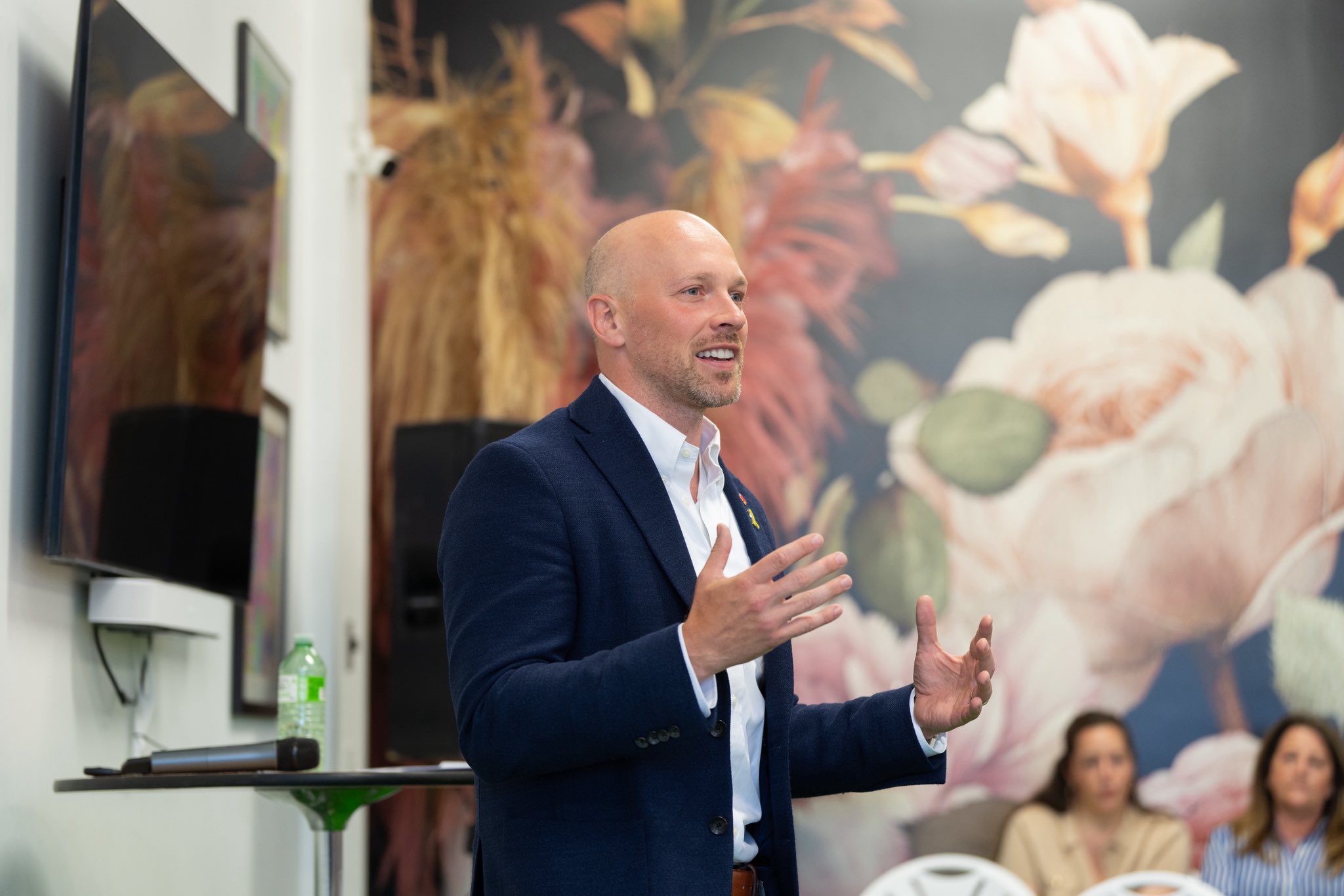
Bradford speaking to supporters in North York.

I’m going to make the case for something that rarely gets anyone’s heart racing: the city budget. Stay with me, because it’s the reason your rent is what it is, the reason the subway is late again, and the reason a first home in this city feels like something that happens to other people and will never happen for you.
Here’s what nobody at City Hall likes to say out loud. Toronto was never poor. Our budget is bigger than 4 provinces. The province has never sent the city more money than it has these past 3 years. And NDP Mayor Olivia Chow still raised property taxes nearly 20%, the largest increase in the city’s history. If she’s re-elected, she’ll raise them another 20% at least.
Over the same stretch, food bank visits climbed 340% since 2019, to 4.1 million last year alone. More money in, more taxes out, and more people in line for groceries. Where did the money go?
A big part of the answer is that the budget rulebook was written in the 1990s. Toronto keeps two budgets: an operating budget that runs the city, and a capital budget that builds it. On paper, they’re separate. In practice, hundreds of millions of dollars a year are moved out of the operating budget, which your property taxes and land transfer tax pay for, to pre-pay capital projects that won’t be built for years.
The City’s own 2026 budget earmarks about $256 million of those transfers for 2027 and $369 million for 2028. Meanwhile, more than $1 billion of last year’s capital budget never got spent. You pay cash up front for things that don’t get built, and then next February, the bill goes up again.
Nobody pays cash for their whole house on move-in day. Ottawa stopped budgeting this way thirty years ago, and Prime Minister Mark Carney has gone further, drawing a clear line between what the country spends to run itself and what it invests to build. Queen’s Park did it 20 years ago under a Liberal government and kept it under a Conservative one. Toronto Hydro has run this way since 1999.
Toronto City Hall is the last holdout among major governments in this country. This isn’t a left or right idea. It’s how serious governments keep their books, and I think a city this ambitious should expect at least that much from itself.
So here’s what I’ll do.
I’m a city planner by training. I know how a city is supposed to work, and I know how to look under the hood. As mayor, I’ll separate the operating and capital budgets for real. The operating budget pays for services out of taxes and fees and balances every year. The capital budget finances transit, water mains and community centres over the life of each asset, under the tightest debt rules in the country: interest never above 4 cents on the dollar, lower than any province, and lower than Chicago, New York or Montreal.
Borrowing is for building. Never for running the place. Not one dollar, and not a single service cut.
End the transfers, and that money goes back to the people who paid it. Start with the municipal double land transfer tax. Toronto is the only city in Canada that charges its own, stacked on top of the provincial one, and it lands on closing day, after you’ve spent years scraping together a down payment. Five figures, in cash.
I’ll eliminate it on the value of a home below $1.1 million, the average price in this city. At the line, that’s about $18,000 you keep. For most first-time buyers in condos, it disappears entirely.
Alongside it: a property tax rate freeze in year one, paid for with money City Hall budgeted and didn’t spend; the first full, independent, line-by-line review of city spending since 2011; and water bills down 25%, about $300 a year for the average household, by making it a publicly-owned utility like Toronto Hydro and like they do in Halifax, Edmonton, and Vancouver.
Olivia Chow stood on the debate stage and declared that Toronto has reached its full potential. I don’t believe that, and I don’t think you do either. We’re not even close. Mayor Chow has made her peace with less. I have not.
Toronto isn’t broken. It’s stuck. And the budget is where it gets unstuck, because a city that stops overtaxing and underbuilding is a city that can afford to be bold again. We’re on the cusp of change. Change is within our grasp. To change the city, we need to change the mayor.
Brad Bradford is running for Mayor of Toronto. We invited the city's two leading mayoral candidates to make their closing arguments to voters in an op-ed ahead of Monday’s election. Read what Olivia Chow has to say here.